चैत्र नवरात्रि २०२४ तारीख| Chait Navratri 2024| Hindi

प्रस्तावना : आज के व्यस्त जीवन में हम लोग अपने व्रत त्यौहार को लगभग भुला गए हैं | यह लेख खास कर युवा में अपने व्रत त्यौहार के प्रति जागरूकता लाने के लिये है | इस आलेख को पढ़ने के बाद अपने त्यौहार , महापुरूषो के प्रति जानकारी प्राप्त करने का रुचि विकसित होगा | इस लेख का यही  उद्देश है  इस लेख में हम चैत्र नवरात्रि के विषय में बहुत कुछ जानेंगे | चैत्र नवरात्रि कँहा कँहा होता है  इसका महत्व एवं बहुत कुछ | 

Keywords :  व्रत |त्यौहार कन्या पूजन |कन्या भोज | कलश स्थापित  | माँ के रूप | चार नवरात्रि | गुप्त नवरात्रि | 

Table of contents

1. चैत्र नवरात्रि  कब मनाया जाता है

2.चैत्र नवरात्रि कँहा  मनाया जाता है

3.चैत्र नवरात्रि  का इतिहास

4.चैत्र नवरात्रि  कई नाम

5.चैत्र नवरात्रि  के पौराणिक कथा

6.चैत्र नवरात्रि   का महत्व 

चैत्र नवरात्रि  कब मनाया जाता है?
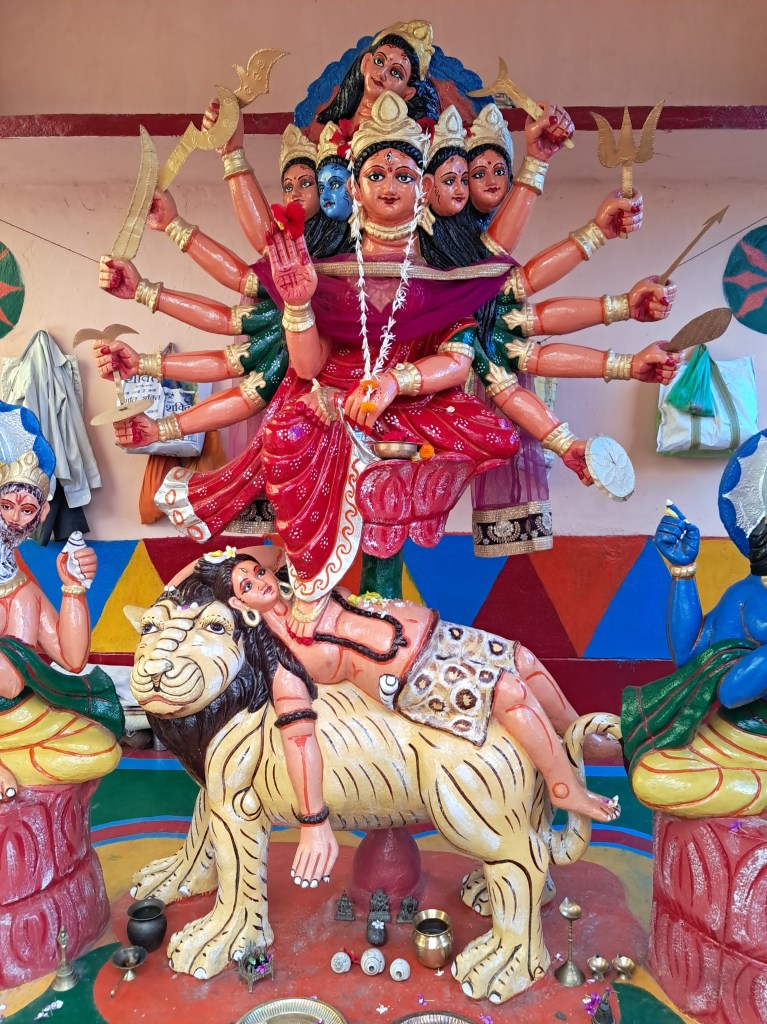
Photo by the author

भारतवर्ष में कई तरह के त्योहार मनाए जाते हैं, चैत्र नवरात्रि का त्योहार उनमें बहुत ही महत्वपूर्ण त्योहार माना जाता है | यह चैत्र माह के शुक्ल  पक्छ से प्रारंभ होकर रामनवी तक चलती है |  भारतवर्ष में कई तरह के त्योहार मनाए जाते हैं, चैत्र नवरात्रि का त्योहार उनमें बहुत ही महत्वपूर्ण त्योहार माना जाता है | 

कलश स्थापना का मुहूर्त ९ अप्रैल को सुबह ७ बज कर ०२ मिनट से १० बज कर १६ मिनट है | इसी दिन – ९ अप्रैल को सर्वार्थ सिद्धि  योग एवं अमृत सिद्धि योग का संयोग है जो सुबह ७ बज कर ३२ मिनट से शाम ५  बज कर ६ मिनट  तक है | 

९ अप्रैल को दोपहर ११ बजकर ३३ मिनट से १२ बज कर २४ मिनट तक अभिजीत मुहूर्त है ,जो किसी शुभ कार्य का शुभारम्भ करने के उपयुक्त है | अगर आप कोई नया काम शुरु करने जा रहे है तो यह सही समय है | 

विद्वानों के अनुसार इस वर्ष नवरात मंगलवार से शुरु हो रहा है ,जिसके कारन माँ दुर्गा का आगमन घोड़े की सवारी से है ,जो अशुभ माना जाता है | परन्तु माँ दयालु है ,९ अप्रैल को पुरे दिन पूजा करने के बाद छमा याचना करने से शुभ फल देंगी | 

१७   अप्रैल २०२४ को रामनवमी मनाया जायेगा| रामनवमी पूजा का ९ अप्रैल को  पूर्वाह्न ११ बजकर १७ मिनट से अपराह्न एक बजकर पैतीस मिनट तक होगा |

चैती छठ का महा पर्व 

नवरात्रि के समय ही चार दिवसीय सूर्योपासना  चैती छठ का महा पर्व  १२ अप्रैल से प्रारंभ हो कर १५ अप्रैल के सुबह तक मनाया जायेगा | चैती छठ १२ अप्रैल से नहाय खाय से  प्रारंभ होगा ,१३ अप्रैल  को  खरने पूजन ,१४ को संध्या अर्घ एवं १५ को सुबह के अर्घ के साथ समाप्त होगा | भारतवर्ष में कई तरह के त्योहार मनाए जाते हैं, चैत्र नवरात्रि  एवं चैती छठ का त्योहार उनमें बहुत ही महत्वपूर्ण त्योहार माना जाता है | 

गर्मी के मौसम  शुरुआत  के साथ ही चैत्र नवरात्रि मनाया जाता है | यह चैत्र माह के शुक्ल  पक्छ से प्रारंभ होकर रामनवी तक चलती है |  भारतवर्ष में कई तरह के त्योहार मनाए जाते हैं, चैत्र नवरात्रि  का त्योहार उनमें बहुत ही महत्वपूर्ण त्योहार माना जाता है | 

 चैत्र नवरात्रि कँहा  मनाया जाता है?

चैत्र नवरात्रि भारत वर्ष का एक बहुत महत्वपूर्ण  पर्व है,जिसे पुरे भारत वर्ष में मनाया जाता है | कुछ राज्यों में जैसे बिहार ,उतर प्रदेश ,असम, झारखण्ड और पश्चिम बंगाल में बहुत उत्साह से मनाया जाता है | अन्य राज्यों में भी इसे मनाया जाता है | इसके आलावा चैत्र नवरात्रि अन्य देशों जैसे अमेरिका ,कनाडा,इंग्लैंड में भी मनाया जाता है |

 चैत्र हिंदी कैलेंडर के अनुसार पहला महीना है | चैत्र नवरात्रि नए वर्ष के पहले दिन से शुरू होता है | इस दिन हिन्दू धर्म के अनुसार नए वर्ष के पहले दिन के रूप में मनाया जाता है | गुजरात में नवरात्रि  डांडिया और गरबा के रुप में पुरे उत्साह से  मनाया जाता है |भारत के कई प्रदेश में नवरात्रि का पहला दिन ,नए वर्ष के पहले दिन के रूप में मनाया जाता है | महाराष्ट्र में यह   ‘गुरु पर्व ‘के रूप में ,कश्मीर में ‘नवरेश ‘ के रूप में मनाया जाता है | 

                                                    चैत्र नवरात्रि  कई नाम

नवरात्रि के अन्य नाम : नराते ,नवरात इत्यादि हैं | 

नवरात्रि एक संस्कृत शब्द है जिसका अर्थ है नौ रातें | इन दिनों माँ दुर्गा  शक्ति रुप के नौ रूपों में पूजा की जाती है एवं दसवां दिन दशहरा मनाया जाता है | चैत्र नवरात्रि में दसवां दिन रामनवमीं के रुप में मनाया जाता है | इस दिन भगवान राम का  जन्म हुआ था | भगवान राम को , विष्णु भगवान  का  सातवें अवतार  मन जाता है | 

नवरात्रि वर्ष  में चार बार में मनाया जाता है | एक नवरात्रि चैत्र में ,दूसरा पौष  में ,तीसरा असाढ और चौथा  माघ माह नवरात्रि में मनाया जाता है | असाढ और माघ माह में ‘गुप्त नवरात्रि  मनाया जाता है | इसमें चैत्र नवरात्रि एवं शारदीय नवरात्रि बहुत महत्वपूर्ण  पर्व है। 

   चैत्र नवरात्रि  के पौराणिक कथा 

भारत में हर त्योहार के पीछे कोई न कोई पुरानी कहानियां होती हैं | उसी के अनुसार भारत वर्ष में त्योहार मनाया जाता है | चैत्र नवरात्रि वैदिक युग से ही मनाया जाता है |   

एक पौराणिक कथा चैत्र नवरात्रि  के विषय में है की, भगवान राम ने चैत्र माह में माँ दुर्गा  की उपासना कर शक्ति प्रताप किया और रावण पर विजय प्राप्त किया था ,इसी  के उप्लक्छ में  चैत्र नवरात्रि मनाया जाता है | ऐसा विश्वास किया जाता है कि नवरात्रि के समय माँ  पृथ्वी पर निवास करती हैं ,अपने भक्तों के बीच रहती हैं | इससे माँ  जल्दी प्रसन्न होती हैं | 

   चैत्र नवरात्रि में भी शरद चैत्र नवरात्रि के तरह माँ भगवती माँ दुर्गा के नौ रूपों की उपासना आराधना की जाती है | 

पहला दिन माँ शैलपुत्री | 

दूसरा दिन माँ ब्रह्मचारिणी

तीसरा दिन माँ चंद्रघंटा 

चौथा दिन माँ कुष्मांडा  

पांचवा दिन माँ स्कंदमाता 

छठा दिन माँ कात्यानी 

सातवां दिन माँ कालरात्रि 

आठवां दिन माँ महागौरी 

नौवां दिन माँ सिद्धदात्री | 

चैत्र नवरात्रि का महत्व 

वैसे तो माँ की साधना किसी भी  वक्त करने से माँ  प्रसन्न होकर आशिर्बाद देती हैं | परन्तु माँ की साधना खास कर अष्ट्मी एवं नौवमीं को करने से माँ  प्रसन्न होकर आशिर्बाद देती हैं | इन दिनों पूजा का ख़ास महत्ता है |अष्ट्मी एवं नौवमीं को कन्या पूजन जिसे कन्या भोज का बहुत महत्व है | बहुत जगह पर कन्या पूजन का आयोजन किया जाता है | इसमें नौ बाल  कन्याओं (जो माँ के रूपों का दर्शाती हैं ) का पूजन किया जाता है |  

नवरात्रि किस तरह मनाते हैं ?

नवरात्रि  के पहले दिन कलश स्थापित कर के पूजा शुरु किया जाता है ,बाद में  माँ  की मूर्ति स्थापित किया जाता है | कुछ लोग घर पर कलश स्थापित कर के पूजा शुरु करते  है | पूजा  पंडाल में  माँ  की मूर्ति स्थापित किया जाता है,छठा दिन भक्तों के लिए पंडाल खोला जाता है | भक्तों की भीड़ माँ के दर्शन के लिए उमड़ परती है | दसवें दिन मूर्ति को प्रवाहित किया जाता है |  

 Hashtags: कन्या पूजन #कन्या भोज#कलश स्थापित# ,माँ के रूप#चार नवरात्रि #गुप्त नवरात्रि#अमृत सिद्धि योग #सर्वार्थ सिद्धि #उदया तिथि#सनातन धर्म# 

इन्हें भी देखें | https://knowledge-festival.blogspot.com/2021/10/maa-durga.html

अस्वीकरण –  इस आलेख में व्यक्त किए गए विचार विभिन्न लेखों]संचार माध्यमों से लिए गए है और सभी सूचनाएँ मूल रुप से प्रस्तुत की गईं है| इस में व्यक्त किए गए विचार लेखक के निजी विचार नहीं हैं तथा इसके लिए किसी भी प्रकार से उत्तरदायी नहीं है| मानवीय भूल ,टंकण भूल भी हो सकता है इसके लिए लेखक किसी भी प्रकार से उत्तरदायी नहीं है|
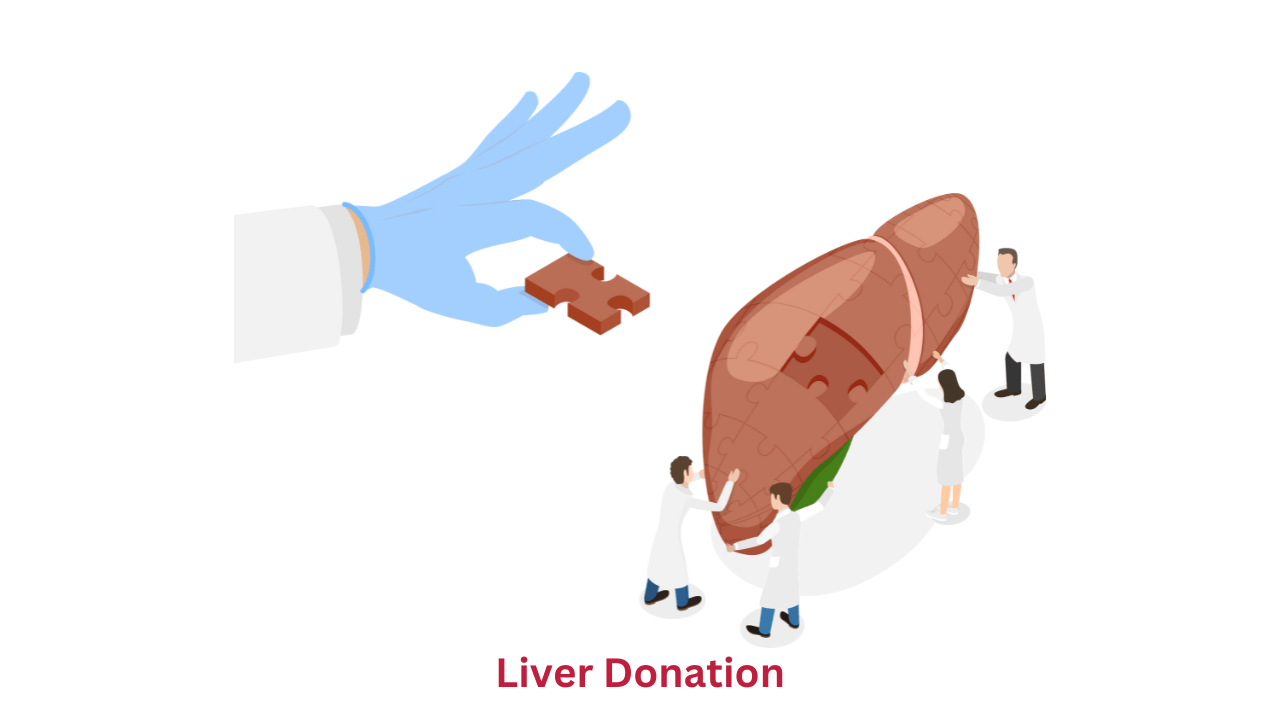
  Liver Donation                                                   


Liver Donation

This article is intended for an international audience of medical care providers and learners.

This activity aims for learners to better apply the latest scientific knowledge.

Upon completing the article, you will have increased knowledge regarding the subject and use it with great confidence.

Liver donation is a pious act of charity. If you donate your liver to someone, you are prolonging his life. You are bestowing life on him.

It is unlike kidney donation, where one whole kidney is removed and donated. In liver donation, only some part of your liver is removed.

In the case of kidneys, dialysis is there to support the patient’s life, but in the case of livers, no such procedure is available to date.

The liver performs more than 500 functions and is unique in its ability to regenerate rapidly. Even when 75% of the liver is removed, it proliferates, attains its standard size, and functions properly.

Donating your liver ( part of it) has no adverse effect on your health, as your liver will regenerate rapidly and function properly.

Living liver donation is a major surgical procedure and carries all complications of surgery as well as that of anesthesia.

Now, liver donation is a very safe operation in specially designated hospitals that provide state-of-the-art techniques. Before donation, experts perform meticulous physical and mental examinations. Counseling is done. A thorough evaluation of your health is performed and certified.

Mortality is only 0.1% and morbidity is 30%.

1. Complications of general surgery and anesthesia.

2. Bleeding

3. Blood clot formation

4. Wound infection

5. Wound dehiscence

6. Bile leaks

7. Hernia

8. Pain and discomfort at the site of incision.

9. Nausea and vomiting.

10. Psychiatric problems may develop anxiety, depression, etc.

11. In some cases, the liver may fail to regenerate or work properly after the removal of a portion of the liver -it may become fatal.

A seven-day hospital stay is mandatory.

It takes about three months for a full recovery.

Disclaimer: All possible measures have been taken to ensure the accuracy and reliability of the information; however, ‘totalphysiology.com’ does not take any liability for using any information provided by the website solely to the viewers. ‘The information is provided as an educational service and public awareness. It is not medical advice. We advise you to review a reference book in case of any doubt and more accurate and advanced knowledge.

If you have any medical issues, we advise you to seek the advice of a qualified doctor and follow his instructions.

                      Who can Donate Blood in India?

H1 Who is eligible for Blood Donation in India?

Adequate blood is vital to life. Without sufficient blood, we cannot survive. Blood is formed in the body; despite tremendous development, we cannot manufacture blood outside our bodies. Therefore, blood donation is of paramount importance to save human lives.

National Voluntary Blood Donation Day is 1st October

H2 Table of contents

Who can donate blood in India?

Criteria of Blood donation?

Who can donate blood in India?

Who can not donate blood in India?

Are there any health benefits for regular blood donors?

Side effects on your health?

Who can donate blood in India?

Criteria of Blood donation?

Let us explain the criteria in detail.

Who can not donate blood in India?

Are there any health benefits for regular blood donors?

When you donate blood, you have some mental and emotional benefits. The Mental Health Foundation reports that giving blood reduces stress and improves emotional well-being. You feel your blood will save at least three lives, leading to happiness in their families. You feel exalted. Some societies will encourage you. Last but not least is your faith that you will get blood in an emergency.

There is no proven beneficial effect on your physical health.

Side effects on your health.

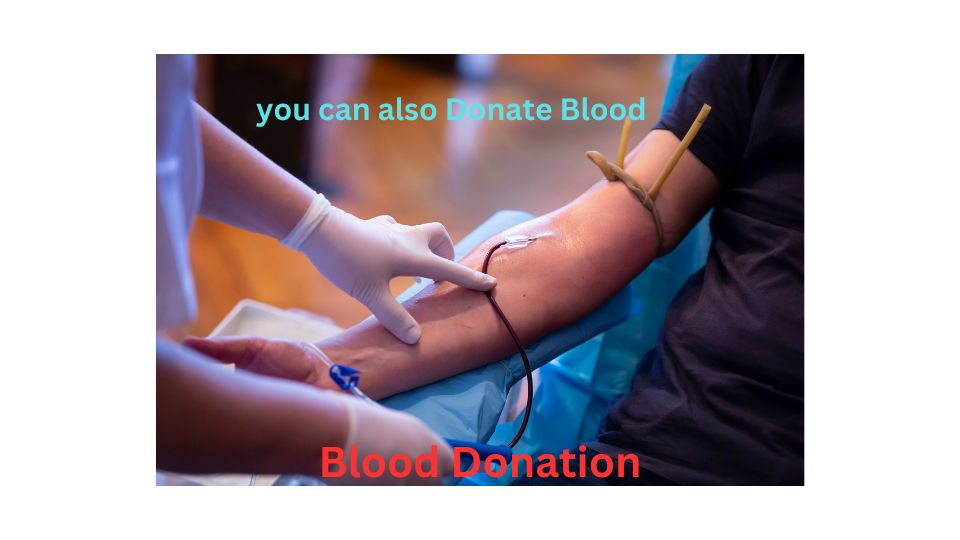
Blood donation is safe. There is no risk of infection, as new sterile equipment is used for each donor, and trained health professionals are present during donation with all life-saving measures.

However, you may feel dizziness, weakness, and pain at the venepuncture site.

FAQ

Can a woman donate blood during pregnancy?

No.

Can a woman donate blood during menstruation?

No.

Can a 17-year-old boy donate blood in India?

In India, he can not donate blood.

Can a 67- year-old donate blood in India?

In India, he can not donate.

How much blood is donated at a time?

About 350 ML.

How much blood is present in one unit?

350 ML

Links:

http://nbtc.naco.gov.in/page/eligibility/%22

https://www.who.int/campaigns/world-blood-donor-day/2018/who-can-give-blood

https://www.google.com/url?sa=t&source=web&rct=j&opi=89978449&url=https://asbtc.assam.gov.in/frontimpotentdata/eligibility-criteria-for-blood-donation&ved=2ahUKEwjf4f_OlJmFAxX8hGMGHYA9DgoQFnoECBEQBQ&usg=AOvVaw1eOOQuGYFj2xfOZGViLmaU

What Is Obesity? Learn the Causes and Effects Of Obesity in Detail

How is obesity defined? What is its prevalence? Let us delve into its causes and effects and how we can eliminate obesity. We will also try to take measures to prevent it. 

Definition: Obesity is the abnormal and excessive fat accumulation in the body. It is a chronic disease associated with other chronic diseases. The word obesity originates from the Latin ‘Obesitas, ‘ meaning fat, stout, or plump. Obesity was known in the early historical period. 

Obesity is related to various conditions and syndromes, especially with Diabetic type 2, osteoarthritis, cardiovascular diseases, hypertension, obstructive sleep apnea, asthma, some cancers, etc.

Incidence: It is more common in females and is prevalent in adults as well as in children. Globally, 650 million people are obese, which is rising rapidly.

Diagnosis: The diagnosis of obesity is based on the Body Mass Index (BMI) and is further evaluated in terms of the Waist-Hip ratio, waist-to-height ratio, and total cardiovascular risk factors.

Category                     BMI Kg/meter square

Underweight                    >̲18.5

Normal weight                   19.5–24.9

Overweight                        25—29.9

Obese class I                      30-34.5

Obese class II                     35-39.9

Obese class III                     >40

Some countries use lower values. For example, in Japan, BMI >25 is considered obese, while in China, it is >28.

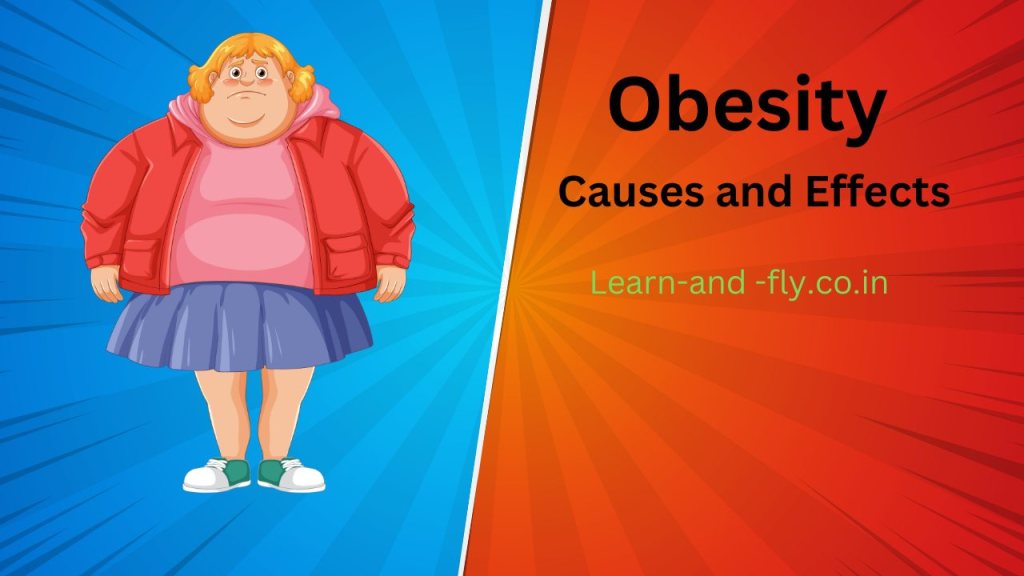
AN OBESE FEMALE FIGURE BY CANVA-

Causes: Obesity is due to 

1. Persistent positive energy balance is responsible for obesity.

2. The body weight set point is raised.

3. Genetic factors: Alterations in the various genes controlling appetite and metabolism predispose to obesity. Fat mass and obesity-associated genes (FTO gene ) are detected. Many hypotheses exist, but none are widely accepted.

Obesity shows inheritance. If both parents are obese, 80% of children will be obese. When both parents are normal, children are only 10% likely to be obese.

It is associated with rare genetic syndromes like Prader-Willi, Bardet-Bedi, Crohn’s, and MOMO.

4. Individual causes are -diet habits, physical activity, and sedentary lifestyle.

A calorie model- excess food intake and lack of physical activity.

5. Eating disorders like ‘binge eating syndrome ‘and night eating syndrome ‘are also responsible for obesity.

Carbohydrate insulin model –High glycemic load causes hormonal changes that promote caloric deposits in adipose tissue.

6. Socioeconomic factors,

Malnutrition in early life causes endocrinal changes, which may promote obesity later.

7. Environmental factors

8. Endocrinal factors: Hypothyroidism, Cushing syndrome, Growth hormone deficiency, etc.

Gut flora also plays a vital role in the development of obesity.

9. Drugs: Insulin, sulfonylurea, steroids, phenytoin contraceptives, and many more.

Obesity increases the risk of clinical depression, and depression increases the chance of developing obesity.

The complications of obesity:

Complications of obesity were well known. The great surgeon of India, Sushruta, had reported about obesity. He related it to heart disease and mentioned that physical activity would cure it.

Obesity directly :
Increases fat mass
Causes osteoarthritis,
Non-alcoholic fatty liver,
Alters the body’s response to Insulin.
Cardiovascular disease,
Hypertension,
Lung diseases,
Mental disorders, depression, anxiety and stress.
Gout,
Low back pain,
Multiple sclerosis,
Carpal tunnel syndrome, etc.
Pregnancy-related complications:

Congenital disabilities

Intrauterine fetal death,

Infertility,

Pregnancy and delivery complications, etc.

In certain conditions, obesity is helpful –positive effect, e.g., in heart failure or hemodialysis. This is the ‘Obesity survival paradox.’

Prevention of obesity:

Lifestyle change-give up smoking and alcoholic drinks.

A healthy and timely diet rich in dietary fiber.

Reduce intake of high fat and high carbohydrate diet

Start an active life.

Regular exercise.

An Introduction to Photoreceptors of the Human Eye

 Introduction

Rods and cones are photoreceptors present in the -retina. Each rod and cone are divided into 1.Outer segment 2.Inner segment, and 3.Synaptic zone.

  1.  Introduction
  2. The outer segments:
  3. Regularly placed piles of flattened discs or saccules of the cell membrane are present in the outer segments of rods and cones. Usually, discs are present in the rods and saccules in the cones. The discs and saccules contain photosensitive pigments.
  4. Photosensitive pigments
  5. The inner segments:
  6. Mitochondria are abundant in the inner segments of rods and cones. The inner segments of rods are thin, but those of cones are thick and large.
  7. Structure and functions of photosensitive pigments
  8. Regeneration of rhodopsin:
  9. The photosensitive pigments are
    1. “Sensitivity range of vision” or “Visibility range of vision”
    2. Types of vision:
      1. Photopic vision: It is daylight vision due to cones. Cones are stimulated at higher intensity of light -about one millilambert (1m A.)
      2. Scotopic or dim light vision is due to rods, and get stimulated below 0.001 m A. Rods are extremely sensitive to light.
      3. Mesopic vision is full moonlight vision, and the brightness level is 0.01m A.
    3. Disclaimer: All possible measures have been taken to ensure the accuracy and reliability of the information; however, ‘totalphysiology.com’ does not take any liability for using any information provided by the website solely to the viewers. ‘The information is provided as an educational service and public awareness. It is not medical advice. We advise you to review a reference book in case of any doubt and more accurate and advanced knowledge.
    4. Subscriber Content
    5. Subscribe to get access

The outer segments:

Regularly placed piles of flattened discs or saccules of the cell membrane are present in the outer segments of rods and cones. Usually, discs are present in the rods and saccules in the cones. The discs and saccules contain photosensitive pigments.

In the rods, the discs are separated from the cell membrane. However, saccules in the cones are formed by the infolding of the cell membrane.

The outer segment of the rod is a thin rod-like structure, while that of the cone is conical.

Photosensitive pigments

The photosensitive pigment in the rod is rhodopsin, which is very light-sensitive. This rhodopsin is responsible for dim light vision, i.e., scotopic vision.

In a cone, the photosensitive pigment is idopsin, responsible for bright light vision, photopic vision, color, and high visual acuity.

The inner segments:

Mitochondria are abundant in the inner segments of rods and cones. The inner segments of rods are thin, but those of cones are thick and large.

Rods are abundant in the human eye. It is estimated that about 120 million and 6 million cones are in each eye.

Rods are abundant in the peripheral parts of the retina and absent in the fovea. Fovea has only cones.

Structure and functions of photosensitive pigments

In rods, the photosensitive pigment is rhodopsin, which is present in the discs. It is coupled to the G-protein and is known as Visual purple.it is purple-red and stimulated by blue-green light with a wavelength of 505nm.

In cones, the photosensitive pigment is idopsin in the saccules. Structures of rhodopsin and idopsin are the same, except the latter has “photopsin” instead of “scotopin.”

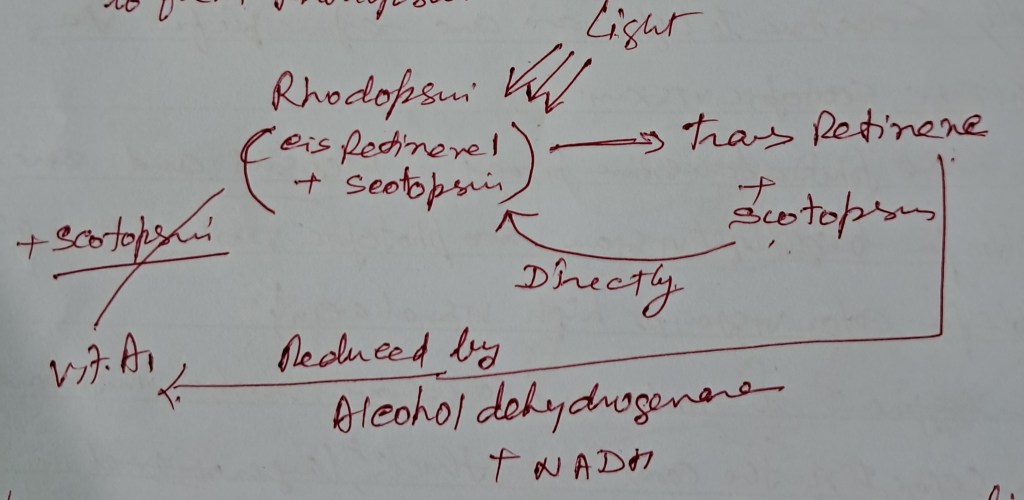
The rhodopsin is composed of 1.retinene1 and scotopin.

Retinene1 is an aldehyde of vitaminA1.

In the dark, retinene is in the 11 cis-form. When light strikes, rhodopsin 11 cis-form is converted into trans-form, and scotopic is released. Rhodopsin gets bleached.

Regeneration of rhodopsin:

1. Some bleached rhodopsin recover directly.

2. The ‘alcohol dehydrogenase’ enzyme reduces the majority of trans-retinene in the presence of NADH to vitamin A1. This, in turn, combines with scotopin to form rhodopsin.

Cones are divided into three types according to the presence of pigments in their saccules.

The photosensitive pigments are

1. Cyanolabe responds maximally to blue light, with a wavelength of 430 nm.

2. Chlorolabe – responds maximally to green light, with a wavelength of 535 nm.

3. Erythrolabe- responds maximally to red light, with a wavelength of 575 nm.

These three pigments are responsible for the primary colors: blue, green, and red. Other colors are a mixture of these colors in different proportions.

“Sensitivity range of vision” or “Visibility range of vision”

Humans can see light of wavelength between 400 nm to 750 nm.

The choroid layer of the retina absorbs ultraviolet light (wavelength of less than 400 nm).

Infrared light has a wavelength above 750 nm, and the cornea absorbs it.

The visual threshold is the minimum amount of light that produces a sensation of light.

Effect of light on rhodopsin and its regeneration.

Types of vision:

Photopic vision: It is daylight vision due to cones. Cones are stimulated at higher intensity of light -about one millilambert (1m A.)

Cones are responsible for bright light vision, color vision, and excellent visual acuity.

Scotopic or dim light vision is due to rods, and get stimulated below 0.001 m A. Rods are extremely sensitive to light.

Between 0.001 to 1 m. A is a transitional zone called the “Duplicity Theory of Vision.”

Mesopic vision is full moonlight vision, and the brightness level is 0.01m A.

Below 0.1 m A, the reading is complex, and prolonged exposure to light 100000 m A will damage the retina.

Disclaimer: All possible measures have been taken to ensure the accuracy and reliability of the information; however, ‘totalphysiology.com’ does not take any liability for using any information provided by the website solely to the viewers. ‘The information is provided as an educational service and public awareness. It is not medical advice. We advise you to review a reference book in case of any doubt and more accurate and advanced knowledge.

Subscribe to get access

Read more of this content when you subscribe today.

Hearing loss and tests

In this article, we will learn about the definition of deafness or hearing loss. We will discuss types of hearing loss, their causes, and much more.

Table of contents:

1. Introduction

2. Types

3. Causes

4. Hearing tests

5. Treatment

Hearing impairment is the inability to hear or the reduction in the hearing capacity of an average person.

Sound waves reach the cochlea in two ways:

1. Through air in the external and middle ear ( air conduction). Sound waves produce movements in the tympanic membrane, which initiates movements in the ossicles present in the middle ear. Movements in the ossicles of the middle ear cause vibration in the basilar membrane.

2.Through skull bones( bony conduction.) Sound waves produce vibrations in the skull bones, including the cochlea, which triggers vibrations in the basilar membrane.

Types:

1. Conductive deafness

2. Neural deafness or sensorineural deafness, and

3. Mixed deafness.

In conductive deafness, there are defects or impairment of functions in the conduction of sound waves. It usually causes incomplete deafness.

In Neural deafness, there may be defects in the conversion of sound waves into action potential and its transmission through the auditory pathway. Neural deafness is also known as ‘central deafness.’ It causes complete deafness.

Mixed deafness is due to causes of conductive and neural deafness.

Common causes of conductive deafness defect in :

1. External ear block in external auditory meatus by wax, foreign body, atresia, or tumor of the external auditory canal.

2. Middle ear:

  • Tympanic membrane perforation of the tympanic membrane, thickening of the tympanic membrane.
  • Infection of middle ear-otitis media.
  • Ossicles- impaired movements in ossicles due to infection.
  • Otosclerosis.
  • Eustachian tube obstruction is usually due to infections.

Common causes of Neural deafness:

1. structure of cochlea

  • Degenerative changes due to ageing-senile degeneration
  • Toxic degeneration of hair cells -drugs,
  • Prolonged exposure to loud sounds.

2. Tumors in the neural pathway or adjacent area compress the pathway.

3. inflammation of the labyrinth- labyrinthitis.

4. Miniere’s disease

5. Trauma of skull.

6. Genetic mutations in some proteins like Connexin 26, Myosin-VI, Myosin-VIIa, Sulfate transport protein, and Barttin.

Genetic mutations will cause mixed deafness.

Hearing tests:

The subject sits on a comfortable chair. The examiner explains the procedure to the subject.

1. Examination of external ears

It starts by examining the external ears, the pinna, and the external auditory meatus.

The pinna is examined for its structure and evidence of any physical abnormalities.

The examiner examines the external auditory meatus. The examiner stands in such a way that he can observe inside the external auditory meatus. The pinna is pulled gently upward and backward to straighten the external auditory meatus.

Points of observation: wax, foreign bodies, and any growth.

Now, an ear speculum is introduced gently in the external auditory meatus. A beam of light is thrown into the ear speculum to visualize the tympanic membrane. The tympanic membrane becomes visible and examined in different directions and positions.

The tympanic membrane is recognized by its oval shape, concavity pointing medially, cone of light, and glistening, shining look.

The center of the tympanic membrane appears depressed-this is the umbo.

The upper part of the tympanic membrane is pinkish and appears flaccid, while the lower and significant part appears blue and tense.

A cone of light-cone-shaped light reflection appears in the antero-inferior quadrant of the tympanic membrane.

If the light reflex is absent or dull- it indicates infection of the middle ear or secretion in the middle ear. It also shows an infection of the external ear.

2. Whisper test

Generally, a person can hear a whisper from a distance of 12-15 inches.

This test is performed in a quiet room. One ear of the subject is occluded, and the examiner is near his other ear. The examiner whispers some simple questions, for example, his name, from a distance of about 15 inches. If the subject hears, he will answer. It indicates that air conduction of that ear is normal.

The procedure is conducted for another ear.

3. Watch test

The subject is asked to close his eyes, occlude one ear, and raise his hand when he hears the watch tick.

The examiner moved a watch from three feet to his open ear and noted the distance when the subject reported hearing the sound.

The procedure is repeated with another ear.

Usually, a healthy subject will hear a tick of a watch from a distance of three feet.

3. Tuning fork tests: Rinne test (Rinnie’s test), Weber test, and Schwabach test. The tests are named after scientists who discovered them.

A few main points

1. You may use a tuning fork of 128/256 or 512-hertz vibrations.

2. Air conduction is better than bone conduction.

Sound is conducted through an ossicular system to the inner ear-cochlear apparatus.

Bone conduction is the conduction of sound through the skull bones.

Aims -1. To know whether hearing impairment /deafness is due to air or bony conduction.

2. To determine whether the hearing impairment is due to conductive or neural defects.

Rinne test:

The examiner explains the procedure to the subject, and the subject is asked to raise one finger as soon as he hears the vibrating sound of the tuning fork and raise two fingers when he cannot hear that.

A tuning fork is made to vibrate by stroking it on your thenar eminence, and the base of the tuning fork is kept on the mastoid process. [The mastoid process is the bony part behind the pinna.]The subject hears the vibrating sound of the tuning fork and raises one finger. He hears the sound by bone conduction.

After that, he raises his two fingers, indicating he cannot hear the sound. Then, immediately, the vibrating tuning fork is placed near his external auditory meatus. He raises one finger to inform that he can listen to the sound. Now, he hears through air conduction.

In this case, air conduction is better than bone conduction, so his hearing ability is average.

Rinne positive means air conduction is better than bone conduction. Rinne’s positive test is normal.

Rinne negative means bone conduction is better than air conduction, indicating that the subject suffers from air conduction deafness.

In this condition, the subject cannot hear the sound when the vibrating tuning fork is placed near his ear after he fails to hear through bone conduction. It means bony conduction is better than air conduction.

One may observe three phenomena:

1. Normal: air conduction is better than bone conduction.

2. Conduction deafness: bone conduction is better than air

conduction.

3. Nerve deafness: no sound is heard, and bone and air conductions are absent.

Weber test:

In this test, a vibrating tuning fork base is placed at the center of the forehead or on the vortex of the subject’s skull with caution.

He is asked to indicate whether he hears the sound equally from both ears or better from one ear.

1. Normally, he hears equally in both ears.

2. In conduction deafness, the subject will hear it louder in the diseased ear.

3. In nerve deafness, the subject hears the sound louder in the normal ear.

This test determines the type of deafness, whether bone conduction deafness or air conduction deafness.

If one ear suffers from nerve deafness, the subject hears the sound better from the opposite ear.

If one suffers from conduction deafness, he will hear better in the diseased ear.

Schwabach test:

In this test, we compare the hearing capacity of the subject with that of the examiner, assuming that the examiner is average.

In this test, a vibrating tuning fork base is placed on the mastoid process of the subject. When the subject cannot hear the sound of the vibrating tuning fork, the examiner immediately puts the base of the fork on his mastoid process.

If the examiner hears the sound, the subject suffers from nerve deafness.

If the examiner cannot hear the sound, the subject suffers from bone conduction deafness.

Audiometry:

Audiometry is the process of objective and subjective tests for hearing impairment.

Audiometry is performed by an electronic equipment called an audiometer, and the record is known as an audiogram. A specialist performs this test.

There are two main types:

Pure tone and speech Audiometry.

Brain stem auditory evoked responses [BAERs]:

Auditory stimulation causes action potential in the auditory pathway, recorded by special electronic equipment in waveforms; this is BAER.

The waves are named I to V depending on the site of their origin.

Wave I from the cochlear nerve

Wave II from the cochlear nerve,

Wave III from the superior olivary nucleus

Wave IV originates from the nucleus of the lateral lemniscus

Wave V arises from the inferior colliculus.

Interference:

The absence or reduced amplitude of waves indicates a lesion of that area and helps in the localization of tumors in the auditory pathways.

.

Subscribe

Enter your email below for updates and a free article PDF.

                       मकर संक्रांति 2024 कब | महत्व

परिचय : भारतवर्ष पर्वो का देश हैं | कुछ बहुत ही  महत्वपूर्ण  होते  हैं | आज के व्यस्त जीवन में युवा पीढ़ी पर्वो के महत्व को भूलते जा रहें है | हर पर्व का महत्व  होता है ,इसके विशेष जागरूकता के लिए इस लेख को पढ़ना जरुरी है | 

  KEYWORD : मकर संक्रांति | कब | क्यू | कैसे | संक्रांति

TABLE OF CONTENT :

१.  मकर संक्रांति पर्व क्या है | 

२. 2024 |मकर संक्रांति कब है |  

३ .  मकर संक्रांति का  महत्व| 

४. 2024 |मकर संक्रांति  क्यू | 

५. 2024|मकर संक्रांति कैसे | 

मकर संक्रांति पर्व क्या है : मकर संक्रांति भारतवर्ष का एक महत्वपूर्ण पर्व है इस दिन तिल गुड़ की बनी मिठाई खाने और बाटने का रिवाज़ है | देश के अलग अलग भाग में इसे अलग अलग नाम से जाना जाता है | इसे तिल संक्रांति ,उत्तरायण और खिचड़ी भी कहा जाता है | मकर संक्रांति पर्व नेपाल में भी मनाया जाता है |


Subscribe to get access

Read more of this content when you subscribe today.

                             मकर संक्रांति कब मनाया जाता है ?

कई  हिन्दू पर्व की तरह ही मकर संक्रांति को मनाने की तारीख में भी संसय हो जाता है | परन्तु हर साल की तरह  जनता इस साल भी १ ४ जनवरी दिन को मनाने का मन बना रखा है | हालाँकि मिथला एवं कांशी पंचांग के अनुसार १५ जनवरी को मकर संक्रांति मनाने को कहा गया है | १५ जनवरी को सुबह आठ बजकर तीस मिनट पर सूर्य धनु राशि से मकर राशि में प्रवेश करेगा ,अतः १५ जनबरी को मनाया जाएगा | हिन्दू मास के पौष माह की शुक्ल पच्छ  की द्वादशीं  को  मनाया जाना है  |

पुण्य काल मुहुर्त पंद्रह जनवरी सुबह  ०८ बजकर ४३ मिनट पर सूर्य धनु राशि से मकर राशि में प्रवेश करेंगे | तब से शाम ५।होगा और इसका समापन  शाम पांच बजकर ४३ मिनट तक पुण्यकाल होगा | 

        मकर संक्रांति का महत्व 

ज्योतिष गणना के अनुसार हर वर्ष बारह संक्रांतिया  होती है | इसमें मकर संक्रांति का खास महत्व है | इस दिन सूर्य मकर राशि में प्रवेश करते है और उत्तरायण  होना  शुरु हो जाते है | इसी कारण मकर संक्रांति को उत्तरायण  भी कहा जाता है | इस दिन से दिन धीरे धीरे  बढने लगता है और रात छोटी होने लगती है | कहावत है की इस दिन से दिन तिल तिल कर बढने लगता है| इसी कारण मकर संक्रांति के दिन तिल दान करने का खास महत्व है | मकर संक्रांति से ही ऋतु बदलने लगता है | शरद ऋतु  का अंत होने लगता है और वसंत ऋतु  प्रांरभ होने लगता है,मौसम गर्म होने लगता है | 

सूर्य हर प्रकार से जीवन को प्रभावित करते हैं | इनके बिना जीवन हो ही नहीं सकता है |  सूर्य परिवार के पिता समान हैं | इनसे  हमारा बहुत गहरा सम्बन्ध है | अतः इस दिन सूर्य की उपासना किया जाता है | 

सूर्य  भगवान के  पुत्र  हैं शनि देव | वे तपस्या ,त्याग,एवं वीतराग के रुप हैं | वे सन्यासी हैं ,सत्य के प्रति समर्पित हैं | धर्म एवं अध्यात्म के लिए शनि देव बहुत जरुरी हैं | अतः इस दिन सूर्य की उपासना के साथ साथ शनी देव की पूजा अर्चना की जाती है ,और दान किया जाता है | 

जिस तरह से ऋतु बदलता है,उसी तरह हमें भी बदलना चाहिए | संक्रांति का शाब्दिक अर्थ  ही है ,बदलाव | इस संक्रांति से हमें भी बदलना चाहिए सर्वश्रेस्ठ गुणों को  अपना कर | 

                             मकर संक्रांति क्यू मनाया जाता है ? 

मकर संक्रांति का खास पौराणिक महत्व है |

एक पौराणिक कथा के अनुसार इसी दिन सूर्य  भगवान अपने पुत्र शनि देव के घर जाते है |  शनि देव को मकर  एवं कुम्भ का स्वामी माना जाता है | पिता पुत्र  के इस अनोखे मिलान के याद मे यह पर्व मनाया जाता है | हिन्दू मास के पौष माह की शुक्ल पच्छ  की द्वादशीं  को  मनाया जाना है  |

एक अन्य कथा के अनुसार इसी दिन विष्णु   भगवान ने पृथ्वी पर असुरो का संहार किया  था तभी से इस जीत कि खुसी मे मकर संक्रांति  पर्व मनाया जाता है | 

एक अन्य विचार के अनुसार देश के कई भागों मे नई फसल कट जाता है | नई फसल का चूड़ा एवं अन्य पकवान खाया जाता है और  भगवान का  आभार प्रकट किया जाता है | 

                              मकर संक्रांति कैसे मनाया  जाता है ?

इस दिन सूर्य भगवान एवं उनके  पुत्र शनि देव के उपासना का विशेष महत्व है | सूर्य भगवान ग्रहों के राजा है ,उनको प्रसन्न  करने के  लिए तिल  एवं अन्य सामाग्री दान करने का खास महत्व है | सूर्य भगवान प्रसन्न  होने पर सुख, शांति शक्ति धन एवं  यश प्रदान करते है | 

शनि देव की उपासना प्रकाश दान करके किया जाता है | 

मकर संक्रांति के दिन पतंग उड़ाने का भी प्रचलन है | 

कोई भी पर्व स्वादिस्ट भोजन के बिना पुरा नहीं होता है ,तो इस पर्व मे भी  कई तरह के स्वादिस्ट पकवान बनाने एवं खाने का प्रचलन है | इस दिन खास कर खिचड़ी खाने का प्रचलन है | 

इतनी जानकारी होने के बाद आइए हम मकर संक्रांति पर्व  को कोविड १ ९ के रोक थाम के मानको का अनुपालन  करते हुए स्वादिस्ट पकवान के साथ मनाएं | 

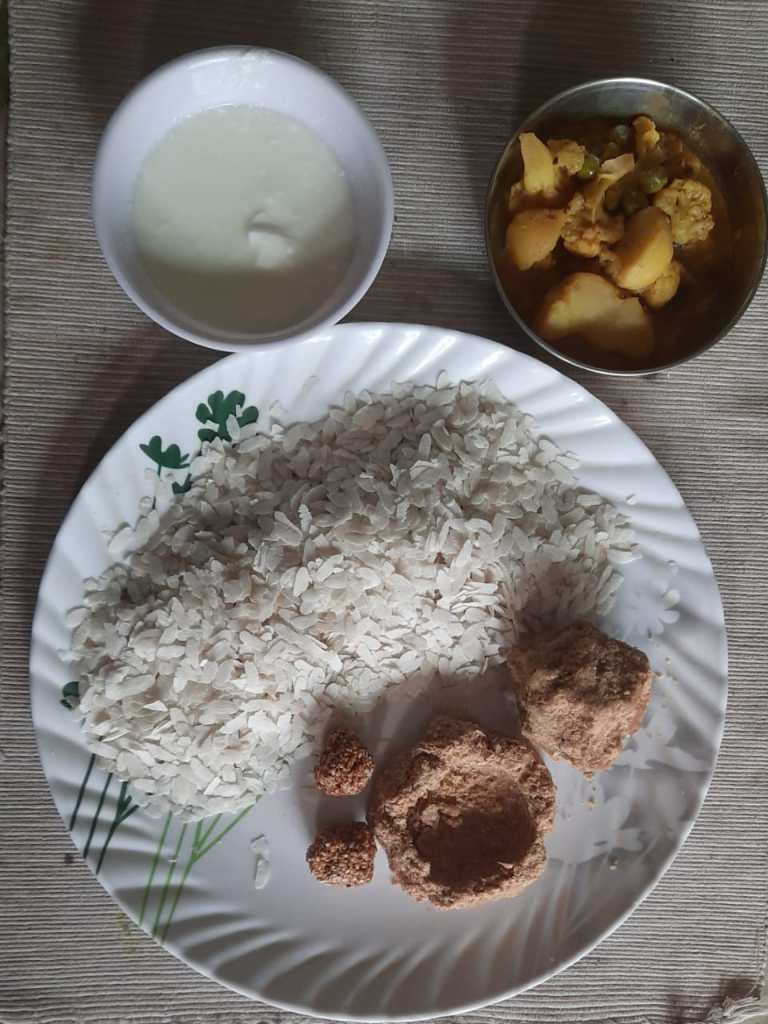
                                                       चुरा ,दही ,तिलकुट ,गुड़ एवम सब्जी 

                                       शुभ मकर संक्रांति  

                Photo by author

अस्वीकरण   इस आलेख में व्यक्त किए गए विचार विभिन्न लेखों]संचार माध्यमों से लिए गए है और सभी सूचनाएँ मूल रुप से प्रस्तुत की गईं है, व्यक्त किए गए विचार लेखक के निजी विचार नहीं हैं तथा इसके लिए किसी भी प्रकार से उत्तरदायी नहीं है| मानवीय भूल ,टंकण भूल भी हो सकता है इसके लिए लेखक किसी भी प्रकार से उत्तरदायी नहीं है|
Endolymphatic potential

In this article, we will learn about ‘potential differences’ between different structures of the inner ear and Cochlear microphone potential, and more.

Table of content

1.Introduction
2.Potential differences
3.Cochlear microphone potential and its features
4.Impedance matching
Table of content

Introduction

Interior of the cells of ‘organ of corti’ stria vascularis and other structures in the inner ear are minus 30 millivolts (-30 mV ) to the perilymph present in the scala vestibuli and scala tympani.

There is no potential difference between perilymph present in the scala vestibuli and scala tympani.

The endolymph in the scala vestibule is positive at 80 mV compared with the perilymph in the scala vestibuli and scala tympani.

The potential difference between:

1. Endolymph +80 mV to perilymph

2. Perilymph to perilymph, no potential difference

3. Internal of cell -30 mV to perilymph.

Cochlear microphone potential

Cochlear microphone potential is one of the electrical responses of the cochlea. It is a potential difference between an active electrode placed on or near the cochlea and an indifferent electrode placed on the mastoid process.

The Amplification of cochlear microphone potential by suitable instruments: the loudspeaker records pure tone; this is why it is called cochlear microphone potential.

(Indifferent electrodes may be placed anywhere on the body.)

This potential is like a generation potential.

A few characteristics of Cochlear microphone potential are:

1. Cochlear microphone potentials show no latency or refractory period.

2. Cochlear microphone potentials do not obey ‘all or none law.’

3. Cochlear microphone potentials are resistant to ischemia

4. Cochlear microphone potentials are resistant to anesthesia.

5. Cochlear microphone potential has a linear relationship to the magnitude of the basilar membrane.

6. Cochlear microphone or generation potential converts mechanical energy into electrical energy.

High-frequency sound produces vibration in the basal part of the basilar membrane.

The middle-frequency sound produces vibration in the middle part, while that of low frequency vibrates the apical part of the basilar membrane.

Impedance matching:

Middle ear ossicles magnify sound intensities by 1.2 to 1.3 times.

The effective surface area of the tympanic membrane is about 50-millimeter squares, and that of the oval window is only 3-millimeter squares. This increases pressure within the middle ear and at the oval window by 22 times. This is referred to as ‘impedance matching.’

सावधान ! क्या आप ऊंचे पहाड़ो पर चढ़ने जा रहें है |  

अगर आप ऊंचे पहाड़ो पर चढ़ने जा रहें है तो इन बातों पर खास ध्यान देना बहुत जरूरी है | पहले तो यह जान लें की ऊंचे पहाड़ किसको कहतें है | 

ऊंचे पहाड़ो की श्रेणी में वे ऊंचे पहाड़ है जिनकी ऊचाई समुद्र तल से  कम से कम २५०० मीटर होती है | कुछ विद्वानों के अनुसार यह ऊचाई ३००० मीटर है | 

अगर आप ऊंचे पहाड़ो पर चढ़ने जा रहें है तो इसके लिए आप पहले से प्रोग्राम बनालें | और कुछ विषेश जानकारी प्राप्त करते है | 

१.  प्रशिक्षक  से प्रशिक्षण करें ,पूर्वा अभ्यास कर लें और संतुस्ट होने पर उनके सलाह से अपना प्रोग्राम बनायें | 

२। ऊंचे पहाड़ो पर धीरे धीरे चढ़ना है | कुछ ऊंचाई के बाद रुकना है | जिससे  शरीर उस वातावरण का अभ्यस्त हो सके | इस तरह धीरेधीरे चढ़ना है | 

३. पहाड़ो पर ऊचाई बढ़ने से वातावरण में ऑक्सीजन का दबाब (प्रेशर) कम हो जाता है | और ऑक्सीजन की कमी महसुस हो ती है | अतः ऑक्सीजन का सिलेंडर एवं मास्क रखना आवश्यक है | धीरे धीरे शरीर उस वातावरण का अभ्यस्त होता है | 

४. ऊंचे पहाड़ो पर चढ़ने के बाद तीन दिनों तक शारीरिक श्रम नही करना है ,यह जानलेवा हो सकता है | तीन दिनों के बाद ही हल्का श्रम नही करना चाहिए | 

५. पहाड़ पर उचाई बढ़ने से तापमान में कमी होता है | एक हज़ार मीटर उचाई बढ़ने से ६ डिग्री सेल्सियस के लगभग तापमान में कमी होता है| अतः गर्म कपड़ों का इंतज़ाम रखना जरुरी है | 

अस्वीकरण: 

यह लेख जनता में जागरुकता लाने एवं जानकारी हेतु लिखा गया है | इसके उपयोग के सारी जिम्मेदारी उपयोग कर्ता की होगी| 

इस आलेख में व्यक्त किए गए विचार विभिन्न लेखों]संचार माध्यमों से लिए गए है और सभी सूचनाएँ मूल रुप से प्रस्तुत की गईं हैSaA व्यक्त किए गए विचार लेखक के निजी विचार नहीं हैं तथा इसके लिए किसी भी प्रकार से उत्तरदायी नहीं है|प्रस्तुत किसी जानकारी को इस्तमाल करने से पहले अपने विवेक का इस्तमाल करें | 

Photo by Joris Eschalier on Pexels.com

गुरु  गोविन्द  सिंह जयंती २०२ ३ | Guru Gobind Singh Jayanti २०२३  |  

     Keywodrs : त्योहार| पटना | प्रकाश पर्व | गुरु तेग बहादुर | त्योहार| गुरुद्वारा| दार्शानिक | आद्यात्मिक | पांच ककार| धर्म ग्रंथों| लंगर| आद्यात्मिक

Table of contents

1. गुरु  गोविन्द  सिंह जयंती  कब मनाया जाता है

2. गुरु  गोविन्द  सिंह जयंती  कँहा  मनाया जाता है

3. गुरु  गोविन्द  सिंह जयंती का इतिहास        

4.  गुरु  गोविन्द  सिंह जयंती कई नाम

5. गुरु  गोविन्द  सिंह जयंती कैसे मनाया जाता है 

6.  गुरु  गोविन्द  सिंह जयंती  का महत्व 

            गुरु  गोविन्द  सिंह जयंती ,  गुरु  गोविन्द  सिंहजीके  जन्म दिवस के रूप में मनाया जाता है | गुरु  गोविन्द  सिंहजीसिखों के दसवें गुरु हैं | गुरु जी  धर्मरक्षक ,कवि और एक महान योद्धा थे |  वे एक आद्यात्मिक गुरु एवं दार्शानिक थे |  गुरु नानक देव जे ने गुरु ग्रन्थ साहिब को पूर्ण किया |  अपना पूरा जीवन जनता के  लिय  अर्पित कर दिया |

                                     गुरु  गोविन्द  सिंह जयंती कब मनाया जाता है

भारतवर्ष में कई तरह के त्योहार मनाए जाते हैं,गुरु  गोविन्द  सिंह जयंती का त्योहार उनमें बहुत ही महत्वपूर्ण त्योहार माना जाता है  खास करके सिख  भाईयों  के लिए | गुरु  गोविन्द  सिंह जयंती पौष माह के शुक्ल  पक्छ की सत्तमी तिथि मनाया जाता है |आज के ही  दिन १९६६ ईस्वी विक्रम संवत को  गुरु  गोविन्द  सिंह जी का जन्म हुआ था | इसी दिन गुरु  गोविन्द  सिंह जी का प्रकाश पर्व मनाया जा रहा है 

इस वर्ष २०२३   में गुरु  गोविन्द  सिंह जयंती  २७ नवम्बर  को मनाया  जाना है | 

गुरु  गोविन्द  सिंह  का जन्म बिहार राज्य की राजधानी पटना में हुआ था | सिख धर्म के नौवें गुरु तेग बहादुर साहेब के इकलौती संतान थे | इनकी माता का नाम   गुजरी देवी था | बचपन में इनका नाम गोविन्द राय  था |  पटना में इनके जन्म स्थल को अब पटना साहेब कहते हैं | 

जन्म के बाद सिर्फ चार वर्ष तक गुरु पटना में रह पाए | इनके पिता एवं सिखों के नौवें गुरु तेग बहादुर साहेब ने धर्म परिवर्तन करने से इंकार कर दिया जिससे औरंगजेब ने उनका सर कलम करवा दिया | इसके बाद २९ मार्च १६७६ को गुरु गोबिंद सिंह जी को १० वा गुरु घोषित किया गया | इसके बाद से बचपन के गोबिंद राय ,गुरु गोविन्द सिंह जी कहलाने लगे | इस वक्त  गुरु  गोविन्द  सिंह  जी दस वर्ष के थे |

                                          गुरु  गोविन्द  सिंह जयंती कँहा  मनाया जाता है

   गुरु  गोविन्द  सिंह जयंतीविश्व में  सभी जगह मनाई जाती है , खास कर जिस स्थान पर सिख भाई रहतें हैं |  हिंदूओ का भी यह महत्वपूर्ण त्योहार हो जाता है | गुरुद्वारा को सजाया जाता है |इस दिन घर को गुरुद्वारों  को ,फूलों से सजाया जाता है ,दीपक जला कर रौशन करते है |  भक्त जान  गुरुद्वारा में भजन प्रार्थना किया जाता है ,पूजा अर्चना किया जाता है | शांति पूर्वक जुलुस का आयोजन किया जाता है | गुरुद्वारा में लंगर का आयोजन होता है |   

गुरु  गोविन्द  सिंह जयंती को भोजन वस्त्र  इत्यादि दान दिया जाता है | इस दिन किए गए दान पुण्य का बहुत महत्वपूर्ण होता है | 

इस दिन घर को फूलों से सजाया जाता है ,शाम को दीपक जला कर रौशन करते है |  

                                         गुरु  गोविन्द  सिंह जयंती  का महत्व 

 सिखों को  पांच ककार  धारण करने का आदेश  गुरु  गोविन्द  सिंह जी ने दिया ,जिसे धारण करना सभी सिखों के लिए  आवश्यक  है | सिख भाई इसका पालन करते हैं | 

आइए  जानते हैं  कि  वे पांच ककार  क्या हैं : 

१.  बाल -बिना कटे बाल २ कड़ा  कलाई पर पहनने के लिया स्टील या लोहा -धातु का कंगन ३. कच्छा – छोटा जांघिया ४. कृपाण छोटा  तलवार   एवं  ५. कंघा एक लकड़ी का कंघा  हैं | 

गुरु  गोविन्द  सिंह जी के जीवन से हमें बहुत प्रेरणा मिलती है | जैसे कि::

 कोई भी परिस्थिति  हो हिम्मत नहीं हारना है ,और कड़ी  मेहनत करना चाहिए| 

धर्म ग्रंथों का आदर करना एवं पढ़ना सुनना चाहिए

धर्म के अनुरूप आचरण करना चाहिए| 

धर्म के रक्षा हर हाल में करना चाहिए| धर्म के रक्षा में जान की भी प्रवाह नहीं करना चाहिए |  

वर्तमान पर ध्यान दे और भविष्य निर्माण का योजना पर काम करना चाहिए | 

यथा संभव जरूरतमंद एवं गरीबों के सहायता करना चाहिए

गुरु  गोविन्द  सिंह जी का आदेश है की अपनी कमाई का दसवां भाग दान करें |  

गुरु  के उपदेश  बहुत ही पवित्र  है | गुरु ग्रन्थ सिखों का सबसे पवित्र ग्रन्थ हैं | भारतवर्ष  एवं अन्य कई देशों के  जन- जन, कन -कन  में गुरु  गोविन्द  सिंह जी  रचे बसें हैं | हर वर्ष गुरु  गोविन्द  सिंह जयंती में गुरु  गोविन्द  सिंह जी  के ज्ञान पर  आधारित व्याख्यान  का आयोजन कई जगहों में  किया जाता है जिससे गुरु  गोविन्द  सिंह जी के विचार का  ज्ञान प्राप्त होता है|  | गुरु  गोविन्द  सिंह जी के बिना भारतवर्ष की कल्पना नहीं की जा सकती है | गुरु  गोविन्द  सिंह जी हर नागरिक  के लिए  एक आदर्श हैं | 

चलिए हमलोग गुरु  गोविन्द  सिंह जी जयंती मनाते है | गुरु  गोविन्द  सिंह जयंती सब को मुबारक हो |

                         गुरु  गोविन्द  सिंह जयंती की हार्दिक बधाई | 

आपने किस तरह से गुरु  गोविन्द  सिंह जयंती  मनाई कमेंट कर मुझे बताये | अपने अमूल्य विचार से अवगत कराना न भूलें  | 

    धन्यबाद 

Hashtags: धार्मिक # उपदेश#पवित्र #त्योहार # पटना # प्रकाश पर्व# गुरु तेग बहादुर # त्योहार # गुरुद्वारा # दार्शानिक# आद्यात्मिक # पांच ककार#धर्म ग्रंथों # लंगर # आद्यात्मिक 

इन्हें भी देखें  

https://knowledge-festival.blogspot.com/2022/05/janki-navami.html

https://knowledge-festival.blogspot.com/2022/04/2022-hanuman-janmotsav-2022.html