Table of contents
Intoduction:
Keywords: Nernst equation | The Goldman-Hodgkin-Katz equation
Nernst Equation
The membrane potential at which net passive flux of that particular ion becomes zero is called the Nernst equilibrium potential for that ion. This equation considers only a single permeable ion in isolation.
The Goldman-Hodgkin-Katz Equation
The Goldman-Hodgkin-Katz equation accounts for multiple diffusible ions (especially sodium, potassium, and chloride) simultaneously to determine the membrane potential.
When an ion moves down its concentration gradient across a selectively permeable cell membrane, it seperates electric charges, creating a transmembrane voltage. But the electrical gradient opposes the concentration gradient with equal force.
The membrane potential at which the net passive movement of that ion is zero is called the Nernst equilibrium potential for that ion. This equation considers only a single permeable ion in isolation.
How to calculate Nernst Equilibrium Equation
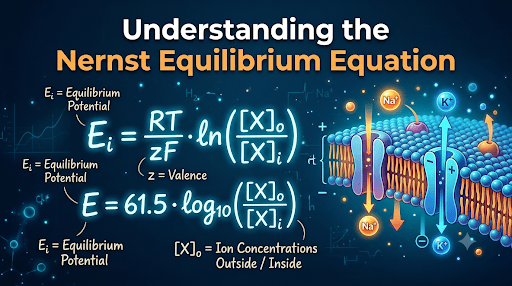
The general thermodynamic form of the equation is
Where E= equilibrium potential for the ion; R = universal gas constant
T = absolute temperature; F = Faraday constant; z = valency of the ion.
Converting the natural logarithm to the form 10^-the simple form is
E ion=61.5/z log 10 [ion out]/[log out]
Calculation of Equilibrium Potential for the Potassium,Sodium and Chloride ions
EK=Equilibrium potential for potassium
EK=61.5/ valency of the ion X 40/140= about -94 mV
valency of potassium is one, so it is 61.5 x 40/140 = about -90 m V.
ENa=Equilibrium potential for Sodium
ENa=61.5/ valency of the ion X 142/14= about +61 mV
valency of Sodium is one, so it is 61.5 x 142/14 = about + 61 m V.
ECl=Equilibrium potential for Chloride.
ECl=61.5/ valency of the ion X 105/4= about -86 mV
valency of chloride is one, so it is 61.5 x 10⁵/4= about -86 m V.
Physiological importance:
Resting membrane potential (RMP) of a large myelin nerve fiber is about -70 mV to -94 mV. This is very close to the equilibrium potential of potassium ions.


Leave a Reply