Table of Contents
Introduction
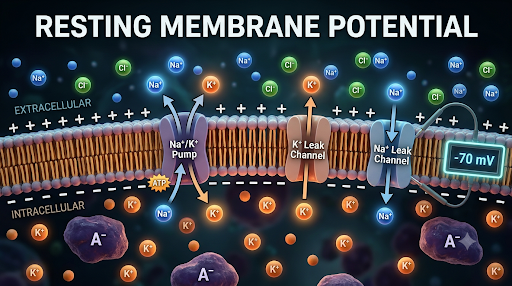
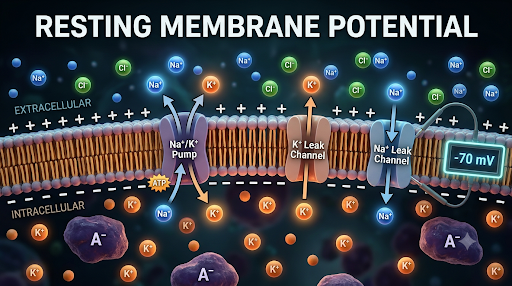
Cell membranes are highly selective, semipermeable membranes that separate the extracellular fluid compartment (ECF) from the intracellular fluid compartment (ICF).
The compositions of ECF and ICF differ markedly in ionic concentrations. For example, Sodium ions are more abundant in ECF, and potassium ions are more abundant in ICF. Anions like Chloride are diffusible, but many anions are non-diffusible, e.g., proteins, phosphates.
Main points to remember are:
- The cell membrane is almost impermeable to Sodium ions.
- The cell membrane is almost impermeable to proteins and phosphate ions.
- The cell membrane is very permeable to Potassium and chloride ions.
- There are many carriers and channels for transport of substances, for example, glucose molecules.
Why are sodium ions with less atomic weight (23) impermeable and potassium ions with atomic weight (39) more permeable?
In the body, ions are present in hydrated form, which alters their effective diameters. In the case of sodium, its atomic weight is 23, but its diameter is 0.18 nm, whereas the atomic weight of potassium is 39, but its diameter is 0.12 nm. Therefore, potassium ions move more easily across the cell membrane.
Gibbs-Donnan Equilibrium and its Clinical importance :
Suppose two cells A and B are separated by a semipermeable membrane. Ions K and Cl are diffusible freely.
Know K in A is equal to K in B: KA = KB and CLA=CLB
And KA = CLA; likewise, KB=CLB;
Product of diffusible ions on A =product of diffusible ions on B
KA × CLA = KB XCLB.
Suppose if cell A has an indiffusable anion P, then
KA= CLA+PA. KA > KB and CLA < CLB.
Therefore, at electrical equilibrium two events occur:
1. The diffusible cation K concentration on the side of the membrane containing the non-diffusible ions P is greater than the diffusible cation K concentration on the other side;
2. The diffusible anion Cl concentration will be greater on the side without the non-diffusible ions.
This is known as Gibbs-Donnan membrane equilibrium.
What are the effects of Gibbs-Donnan :
There will be an electrical difference across the cell membrane. The interior of the cell is negative relative to its exterior. The magnitude of the potential difference in rest depends on its type. We will learn about the Nernst equation.
Because of protein anions and other organic molecules in the cells, there are more osmotically active particles in the cells than the interstitial fluid. This draws water into the cells, causing them to swell and potentially rupture. But sodium-potassium pumps are present in cell membranes, which remove three sodium ions from the cell and allow the entry of two potassium ions into the cell, thereby maintaining osmotic equilibrium between the inside and outside of the cell.
Learning will enrich your knowledge, enabling you to soar high and achieve your maximum potential in life; the sky is the limit.


Leave a Reply