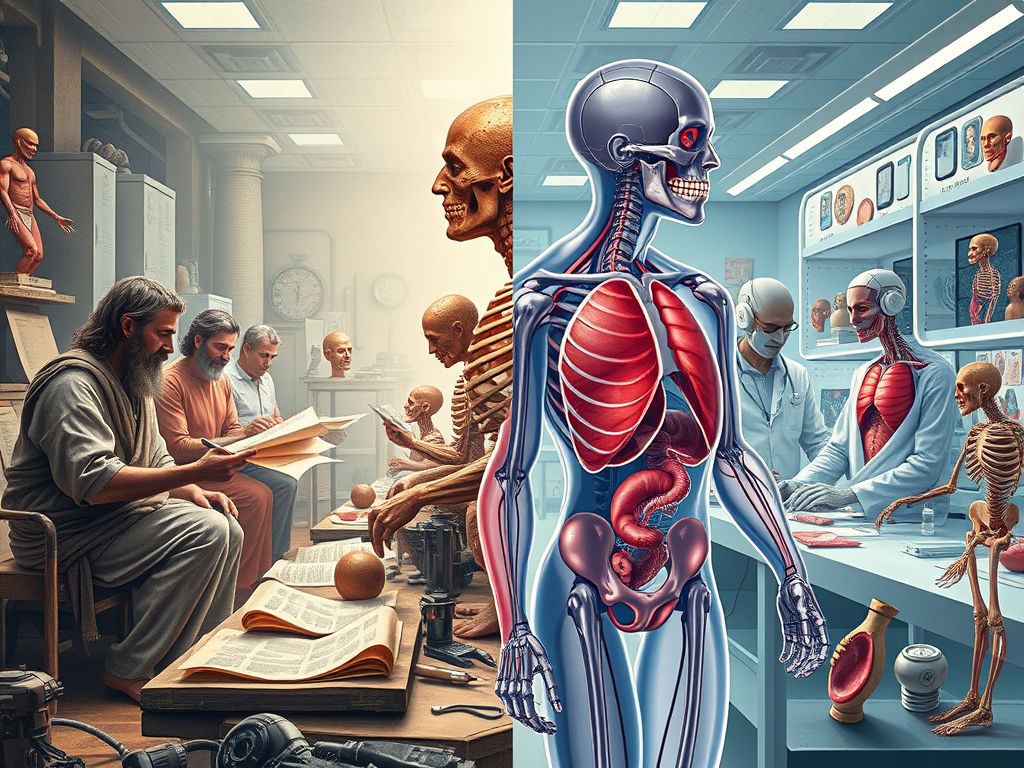
This article describes physiology, with a special focus on human physiology and its various branches. Here, learn about the past, present, future, and scope of physiology. In short, physiology refers to the study of living organisms.
My mission is to provide trustworthy, recent health information to the general public, patients, and professionals globally.
- Past: Developments of human physiology
- Present: Integration of Physiology with Modern Science
- Future: Digital, Personalised, and Predictive Physiology
- Scopes in physiology
- Promising career
Introduction:
Physiology refers to the study of the functions of living organisms. It is divided into many branches. We are concerned with Human Physiology. In Physiology, we learn about the mechanisms that control body functions.
Physiology is the branch of biological science that deals with the functioning of living organisms. It also describes the organs that initiate and control these functions.
A French physician, Jean Fernel (1497-1558), introduced the word “physiology” for the first time.
The word “physiology” is derived from a Greek word with a Latin equivalent, “Physiologia,” which means natural knowledge. Physiology comes from two words: physis, meaning ” nature”, and logia, which means” study”.
The ancient Greek phrase” nature origin” and its study indicate an innate scientific understanding of a living body’s station, functions, and mechanisms.
Physiology is the branch of life science that deals with body functions and how these functions occur in a controlled manner. It also describes the organs that initiate and maintain these functions.
A living organism comprises different organs that respond to environmental changes to survive. Body organs function in such a way that mild variations in the external environment cannot alter the body’s internal environment, which is maintained within a normal range by a mechanism known as homeostasis.
Past: Developments of human physiology
The study of human physiology has been ongoing for time immemorial. The first authentic available record is found in the Sushruta Samhita and Charak Samhita, dating back to around 600 BCE. They proposed that vata, pitta, and kapha regulate the body’s functions.
Documents reveal that the study of medical or human physiology started at the time of Hippocrates, i.e., late 5th century BC, in Greece.
Later, many scientists, philosophers, and thinkers contributed to the development of physiology. Some of them are Galen, Aristotle, Claude Berard, Walter B. Cannon, and many others.
However, their knowledge was speculative and descriptive, lacking scientific experimental support.
A breakthrough came with Galen (129–200 AD), a Roman physician who performed animal dissections and produced detailed anatomical and physiological texts. However, many of his theories were eventually discarded with the advent of new scientific procedures and technology.
William Harvey and many others in the 17th century revolutionised physiology by describing the functions of many organs and systems supported by experiments.
Present: Integration of Physiology with Modern Science
A living organism is composed of many different organs that respond to changes in both its internal and external environments. Any shift in physiology will impact an individual’s physical and mental functions. The study of physiology focuses on the organs, systems, and the biological basis of the human body’s operations.
Physiological condition refers to the normal function of the body, while pathological condition refers to altered physiology, or abnormal conditions.
Physiological function depends on
1. Biophysical processes
2. Biochemical processes,
3. Homeostatic control
4. Rapid and precise communication between cells occurs in various ways, for example, through chemical and electrical methods.
Animal experiments have provided deep knowledge of human physiology. Physiology is a core component of medical studies worldwide, and many universities offer bachelor’s, master’s, and doctoral degrees in the field of physiology.
Modern human physiology encompasses biology, physics, and chemistry, enabling a precise understanding at the cellular, tissue, organ, and systemic levels.
Today, physiology is not limited to describing functions but explaining them through evidence-based mechanisms.
Branches of Physiology:
1. Cellular and Molecular Physiology:
Cellular and molecular physiology explores the roles of ion channels, neurotransmitters, hormones, and genes in regulating various bodily functions.
2. Systems Physiology:
Cells form organs, and organs form systems such as the nervous, cardiovascular, respiratory, renal, endocrine, gastrointestinal, and reproductive systems. Systems Physiology is now studied with integrated perspectives.
3. Diagnostic and Imaging Advances:
Technologies such as MRI, CT scans, PET scans, echocardiography, and EEG enable the real-time observation of physiological processes. These tools provide insights into how systems respond normally.
4. Computational Physiology:
Physiological data is now being analysed through mathematical models and simulations. This computational approach facilitates the prediction of outcomes, simulation of diseases, and testing of potential treatments, thereby reducing reliance on invasive procedures or animal models.
5. Education and Research:
In medical education, physiology is taught not only as an academic subject but as a clinical science. It forms the backbone of medical science. Modern teaching aids, including the use of simulations, virtual labs, and interactive models, have significantly enhanced learning and retention.
6. Sports physiology:
Sports physiology deals with the study of the physiological challenges associated with sports. And how to deal with them in an integrated manner.
7. Genetic counselling:
Nowadays, genetic counselling is available to prevent many hereditary diseases.
Future: Digital, Personalised, and Predictive Physiology
The future of human physiology lies at the intersection of advanced technologies, artificial intelligence, genomics, and personalised medicine. The coming decades promise profound transformations in how we understand and apply physiological principles.
1. Artificial Intelligence:
AI can analyse massive physiological datasets, such as ECG recordings, imaging scans, and genetic data, to identify patterns and predict health outcomes.
2. Machine learning models will assist in diagnosing conditions like arrhythmias, respiratory failure, or hormonal imbalances based on real-time physiological inputs.
3. Personalised Physiology and Genomics:
Understanding the human genome has opened the door to personalised medicine. Future physiology will not generalise bodily functions but will consider an individual’s genetic, epigenetic, and environmental factors.
4. Bioengineering and Artificial Organs:
Bioengineered tissues or artificial organs may replicate physiological functions.
Organs-on-chips and 3D bioprinting aim to mimic real physiological responses, offering potential solutions for organ failure. Research is ongoing into bionic limbs that respond to nerve impulses, replicating natural movement.
5. Devices and Remote Monitoring devices at affordable prices are available:
Smartwatches, pulse oximeters, and biosensors are used to measure heart rate, oxygen concentration, respiratory rate, and blood glucose levels. Digital blood pressure machines enable you to measure your blood pressure accurately. These machines are available at affordable prices.
Devices to monitor additional parameters, such as hormone levels, electrolyte balance, and blood pressure in real-time, are in development.
6. Space and Extreme Physiology:
As humans venture into space and colonise new environments, understanding how extreme conditions affect physiology will become crucial. Microgravity research has already revealed changes in bone density, cardiovascular function, and immunity. Future studies will investigate methods for preserving human physiology under such conditions.
7. Neurophysiology and Brain-Machine Interfaces:
Neurophysiology is rapidly advancing with the development of brain-machine interfaces. Devices like Neuralink aim to decode brain signals to control prosthetics or communicate directly with computers. Such breakthroughs could revolutionise care for patients with paralysis or neurodegenerative disorders.
Scopes in physiology
Physiology is a primary subject of medical degrees worldwide. Many universities offer bachelor’s, master’s, and doctoral degrees in the field of physiology.
Physiology is an essential subject in medical education for M.B.B.S. degrees and is included in the 1st professional curriculum of M.B.B.S.
B.Sc. M.Sc. and PhD physiology courses are also available in many universities.
A physiologist may get posted in medical colleges as a tutor, assistant, associate Professor, or Professor.
Exercise physiology is the study of human physical activity and exercise. The word exercise comes from the Latin word drive forth.”
Exercise has been considered essential to human health for thousands of years in ancient cultures. The Greek physician Hippocrates recognized the importance of exercise and advocated for daily physical activity to maintain good health.
Many career opportunities exist in exercise physiology.
As physiology advances, several jobs are likely to increase in demand.
An exercise physiologist may pursue research work.
Physiologists can work in various clinical settings,
including fitness centers, community organizations, and corporate fitness.
Sports physiologists may start private fitness clinics.
A physiologist may also begin their general clinic.
Hospitals, community facilities, industries, and nursing homes may employ clinical physiologists.
Promising career
A physiologist has a promising career.
Physiology has a promising future, but it faces multifaceted challenges. With the advancement of science and technology, physiology is evolving rapidly. Integrating massive datasets requires strict data privacy protocols. The human body is a highly complex system, and simulations may not fully capture its intricacies.
Ethical concerns also surround interventions like gene editing or neural implants.
Take-home message
A persistent quest to understand life causes the evolution of human physiology.
Physiology is a fascinating and dynamic subject that underpins translational and clinical medicine, as well as the interface between the physical and life sciences. By studying human physiology, we gain insight into how the body maintains normal health and responds to and adapts to challenges in both internal and external environments.
Today, physiology is more integrated, evidence-based, and technologically empowered than ever. It is developing very rapidly.
Looking forward, it will become even more personalised, predictive, and digital, shaping the future of healthcare and medical science.
For M.B.B.S. students and aspiring doctors, mastering physiology is not just about passing exams — it is about developing a scientific foundation that will support every future clinical decision.
Hashtags: Hippocrates # homeostasis # exercise #physiology # sports physiology# divisions #clinical# scopes #
Internal Link: https://blog.totalphysiology.com/2022/01/homeostasis external-internal.html
External Link:
1.https://en.m.wikipedia.org/wiki
2. Entin, Pauline (n.d.)”ABrie” History of ExercisePhysiolPhysiology’rn Arizona University Retrieved 2017-06-30 from
http://jan.ucc.nau.edu/pe/exs336historyVA1.htm.
3. Ivy.John L.(2007). Exercise Physiology: Brief History and Recommendations Regarding Content Requirements for the Kinesiology Major. 59:34-411.
 learn-and-fly.co.in