Table of Contents:
Introduction
Henderson and Hasselbalch Equation
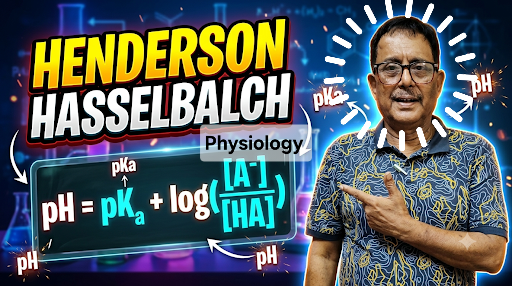
pH=pK +log A– /HA
This equation was originally described and derived by Henderson and Hasselbalch. This equation describes the pH changes resulting from the addition of hydrogen ions or hydroxyl ions.
The Henderson-Hasselbalch equation defines the relationship between pH and the dissociation constant (pK) of a weak acid, and the ratio of the conjugate base to the weak acid.
It is clear from this equation that the buffer capacity of a buffer system is greatest when the amount of free anion equals the amount of undissociated HA. i.e A– /HA =1.so that log A– /HA =0, pH=pK.
Normal range of pH of plasma is 7.35 to 7.45 (average is 7.4)
When the plasma pH is below 7.35, this is known as acidosis.
And when it is more than 7.45, it is alkalosis.
pH compatible with life is 6.8 to 7.8.
The pH of body fluids varies across body fluids.
What is Anion Gap
When the sum of anions in a solution is subtracted from the sum of cations, the result is known as the anion gap of that solution.
Normal is 8 to12.
= [sodium ions] –[chloride ions]-[bicarbonate ions]
140-100-20=AG=20
Do not forget albumin concentration.
In this example, the anion gap exceeds 12; therefore, the sample is acidic.
Buffer systems:
Three buffer systems operate simultaneously:
1. Buffer systems that act immediately
2. Intermediate-acting respiratory buffer systems
3. Long-acting renal buffer systems
Buffer systems that act immediately
Carbonic-Bicarbonate Buffer systems mainly extracellular
Dibasic Phosphate buffer system- intracellular
Ammonia buffer systems
Intermediate-acting respiratory buffer systems
Respiratory system acts intermediately -it removes CO2 ( volatile acid), so hydrogen ions are removed. If respiratory rate increases, CO2 is removed, so H+ is removed; when respiratory rate decreases, CO2 is retained in the body, so H+ is retained.
Long-acting renal buffer system
The kidney controls the body’s buffer system by excreting hydrogen ions and retaining bicarbonate ions.
When acidosis occurs, kidneys excrete hydrogen ions, and when alkalosis occurs, kidneys retain hydrogen ions. This restores the body’s pH.

