
Total Body Water |Average| Measurements| Distribution | Body water chart
Meta description: In human physiology, body water refers to water in the human body. Water covers about 70 to 75% of Earth’s surface. It is present everywhere and in large amounts in living organisms, including humans. In humans, it accounts for about 60% of total body weight.
Keywords:Extracellular fluid | Interstitial | Intracellular fluid| Composition of Plasma | Cholesterol | Phospholipids.|
- Total Body Water |Average| Measurements| Distribution | Body water chart
- Average total body water
- Sources of water gain
- Sources of water loss:
- Measurement of total body water volume
- 1. Flowing-afterglow mass spectrometry (FA-MS) in this method, the subject ingests a known amount of D2O (heavy water). After some time, the abundance of ‘deuterion’ is estimated in water vapor in the exhaled breath sample.
- 2. Indicator dilution principle: Methods based on this principle measure extracellular fluid and plasma volume.
- 3. The Bioelectrical Impedance analysis method analyses total body water %. This is a non-invasive, simple, and low-cost method, and it is now widely accepted to determine total body water.
- Calculation of total body water
- Functions of body water
- Introduction
- Sources of water
- Sources of water loss
- Average total body water
- Different compartment
- Measurements
- Calculation
- Functions
This article is part of my mission to provide trustworthy, recent health information to support the general public, patients, and professionals globally. Here you will find information on human Physiology, Anatomy, and health-related topics. Knowledge of human physiology will help protect your health.
Introduction
This article discusses different aspects of water in the body. Learn how the body gets water and how to remove it.
The human body has 60% water of total body weight. Protein contributes about 18%, fat 15%, and mineral body 7% of total body weight.
Our body is mostly water and distributed in different compartments. The average body fluid in adult males is about 60% water, in females, 55%, and in infants and children, about 70% of total body weight.
International Water Day: 22 March is International Water Day to recognize the significance of water in the human body and universe.
Average total body water
Total body water depends on age, sex, and adiposity.
In males -60% of body weight. In males range is 58 ± 8 %.’
In females -50-55% of body weight. In females range is 48 ± 6%.’
In obese people -45% of body weight. Because fat tissue contains only 10% of water, while muscle tissue contains 75%.
In infants -65-70% of body weight.
For example, water in a person of 60 kg is 60×60=3600/100 =36 liter. Or 36 kilograms.
Sources of water gain
Total body water –water comes into the body by:
1. Liquid ingestion and water in food -2100 ml/day varies according to habits, climate, etc.
2. Formed in the body from metabolism. Due to the oxidation of carbohydrates -200 ml/day.
Total =2300 ml/day.
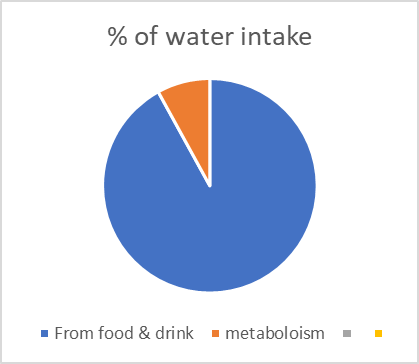
Chart showing % of water intake in health
Sources of water loss:
Water loss from the body
1. Insensible water loss from skin:350 ml/day
2. Insensible water loss from lungs:350 ml/day.
3. Sweat ——————————- 100ml/day.
4. Faeces——————————— 100 ml/day.
5.Urine ———————————–1400 ml/day.
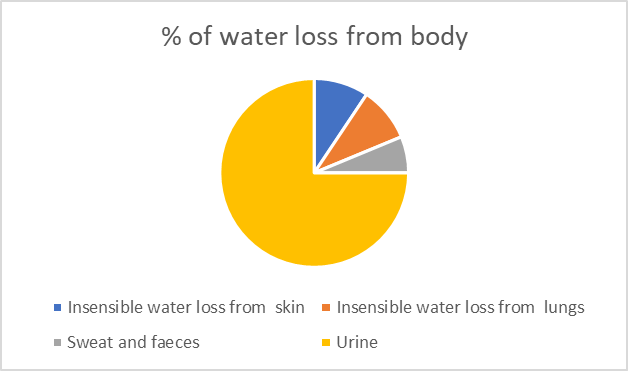
Chart showing % of water loss from the human body
The human body has 60% water of total body weight. Protein contributes about 18%, fat 15%, and mineral body 7% of total body weight. In old age and malnutrition, the total body water is less.
Water forms 45% of body weight in obese people because fat cells contain only 10% of water, while muscle tissues contain 75%.
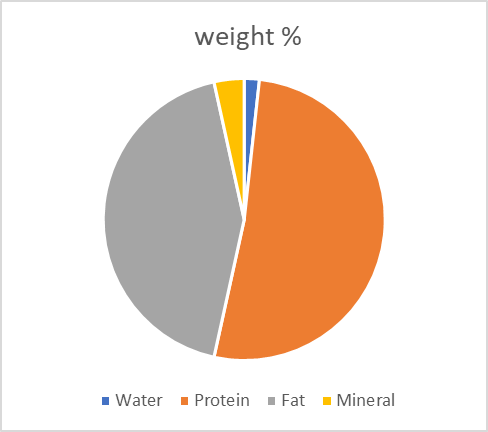
% Contribution of water, protein, fat, and minerals in body composition
In human physiology, body water describes water present in the human body. It varies due to many factors, like age, sex, obesity, nutritional conditions, and environment.
In males, 60% of body weight.
In females, 50-55% of body weight.
In infants, 65-70% of body weight.
Detail of body water % charts and table form, showing effects of age and sex.
| Sex | Age in years | ||
| Healthy male Range Average | 12 to 18 | 19 to 49 | 50 and above |
| 52 to 66% 60% | 43 to 72 % 60% | 47 to 67% 56% | |
| Healthy female Range in % Average in % | |||
| 49 to 63% | 41 to 60% | 39 to 57 | |
| 56% | 50% | 47% | |
Total body water as % of body weight in infants and children :
| Both sex | Upto six month | 6 months to 1 year | 1 to 12 years. |
| Range in % | 65 to 85 | 55 to 65 | 50 to 75 |
| Average in % | 74 | 60 | 60 |
Total body water is distributed in the following compartments :
1. Extracellular fluid 20% of body weight 14 L
a. Interstitial fluid and 11 L
b. Blood Plasma 3L.
c. Transcellular Fluid 1-2 L.
2. Intracellular fluid. about 40% 28 L
The blood volume of adults is about 80 ml/kg of body weight, which is 8% of the total body weight. The average volume is 5L.
Blood Plasma is about 3L.
Transcellular fluid is usually not taken into account in calculations. It is present in the third space—in the organs, for example, the gastrointestinal tract, the cerebrospinal space as cerebrospinal fluid, the urinary bladder, and other organs.
These data may vary depending on many factors, such as methodology and sample size.
Measurement of total body water volume
Total body water measurement is performed by
1. Flowing-afterglow mass spectrometry (FA-MS) in this method, the subject ingests a known amount of D2O (heavy water). After some time, the abundance of ‘deuterion’ is estimated in water vapor in the exhaled breath sample.
2. Indicator dilution principle: Methods based on this principle measure extracellular fluid and plasma volume.
Extracellular fluid(water) estimation: Inulin is used.
Evans Blue dye, Raio-iodinated human serum albumin (RISA), Raio-iodinated human gamma globulin, and fibrinogen are used for plasma volume measurement.
It is not possible to directly estimate intracellular water. It is estimated by subtracting extracellular fluid from total body water.
Intracellular water = Total body water- Extracellular fluid.
3. The Bioelectrical Impedance analysis method analyses total body water %. This is a non-invasive, simple, and low-cost method, and it is now widely accepted to determine total body water.
Calculation of total body water
Total body water is calculated by
TBW= body weight in kilograms x C (co-efficient factor).
The value of C is 0.6 for non-elderly males.
The value of C is 0.5 for adult females, elderly males, and malnourished males and females.
The value of C is 0.45 for elderly females.
We can calculate total body water in healthy adults using anthropometric equations. But these methods are of limited value. One such equation is Watson’s equation.
“The equations that gave the best fit were for males: total body water = 2.447 − 0.09516 A + 0.1074 height + 0.3362 weight (liters) (yr) (cm) (kg) (SD: 3.76, r2: 70.4%) and for females: total body water = −2.097 + 0.1069 height + 0.2466 weight (liters) (cm) (kg) (SD: 3.60, r2: 73.6%). Numerous other linear regression equations are present, but none are widely accepted.
https://doi.org/10.1093%2Fajcn%2F33.1.27
Functions of body water
Life is not possible without water. We can not survive without water. The functions of water in the human body are:
1. Solvent for all organic and inorganic substances in the human body.
2. Transportation of nutrients, hormones, electrolytes, and waste products of metabolism.
3. As a medium for heat loss.
4. Lubricates joints -in synovial fluid.
5.Shock absorber as in cerebrospinal fluid, pleural fluid, and pericardial fluid.
6. Water is present in the gastrointestinal tract, saliva, bile, gastric juice, and intestinal secretions.
7. Buffer action.
8. Provides viscosity.
9. Provides acid-base balance.
10. Blood coagulation.
Total body water is regulated by a homeostatic mechanism, including centers in the brain, hormones, ADH, Aldosterone, Renal mechanisms, and much more.
FAQ:
Q1. How do we calculate a total body water deficiency?
A . The following equation calculates a total body water deficiency or deficit (TBWD):
TBWD=TBW x (1- [Na+]t/ [Na+]m)
Where [Na+]t is the targeted [Na+] ion concentration, usually 140 mEq/liter, and [Na+]m is the measured concentration of [Na+].
2. How do you calculate your water percentage?
A. You can calculate your water percentage by dividing your ‘total body water’ by 60, which gives your water percentage.
3. How do I maintain a healthy water %?
A. Calculate how much water you must drink to maintain health. Weigh yourself in pounds and divide it by 2. The result in ounces will give the amount of water you must drink to maintain normal health. One pound = about 0.4535 kg, and one ounce =30 ml (approximate).
HASHTAGS: Extracellular fluid # Interstitial # Intracellular fluid# Distribution#Body water charts# Calculation# Functions #
 learn-and-fly.co.in
One thought on “ Total Body Water”