
Definition
What is a cell?
A cell is the structural and functional unit of life. The word originates from the Latin ‘Cellula,’ meaning small room.
Robert Hook discovered cells in 1665 and named them cells due to their resemblance with cells inhabited by Christian monks in a monastery.
Matthias Jakob Schleiden and Theodor Schwann proposed the ‘Cell theory.’According to this cell theory, cells are the basic unit of life. The cells are structural and functional units in living organisms. All organisms have single or multiple cells. Although unicellular organisms are also present.
About four billion years ago, cells appeared on Earth. At first, unicellular organisms appeared on Earth, probably in the sea. In the course of evolution, multicellular organisms developed.
Life starts from a single cell. After that, cells come from pre-existing cells through sexual or asexual divisions.
Every cell’s outer layer or covering is the cell or plasma membrane, which encloses the cytoplasm. In the cytoplasm, many organelles are present, such as the nucleus, mitochondria, Golgi apparatus, endoplasmic reticulum, and more, along with organic and inorganic molecules.
Types of cells
There are two types of cells:
Eukaryotic -cell with a nucleus
Prokaryotic -cell without a nucleus, but a nucleoid region is present.
According to the presence of prokaryotic cells, the organism is known as Prokaryocytes, usually single-celled -unicellular organisms. For example, bacteria and archaea.
Eukaryocytes have eukaryotic cells and may be unicellular or multicellular, e.g., Fungi, plants, and animals.
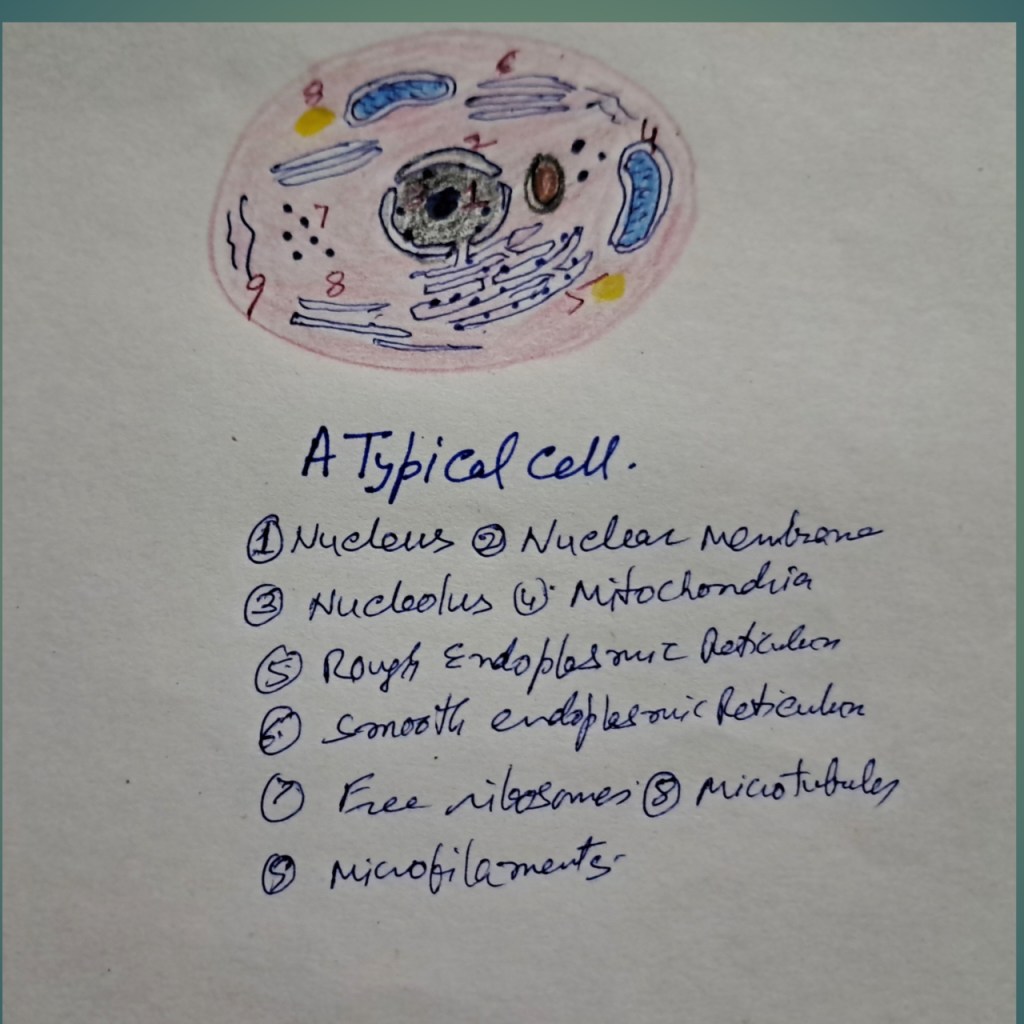
CELL MEMBRANE
The cell membrane is also known as the plasma membrane or simply membrane. Plasmalemma is a less commonly used term for the plasma membrane.
This surrounds a cell and separates the interior of the cell from the exterior and from other cells. It is a very thin layer with about 70 to 100-angstrom thickness.[1A=10-10 mts. ] One angstrom is equal to 10 nanometer.
Structure of the cell membrane:
The cell membrane is also known as the plasma membrane or simply membrane. Plasmalemma is a less commonly used term for the plasma membrane. This surrounds a cell and separates the interior of the cell from the exterior and from other cells. It is a very thin layer with about 70 to 100-angstrom thickness.[1A=10-10 mts. ] One angstrom is equal to 10 nanometers.
Structure of the cell membrane:
The cell membrane consists of a double layer of lipids- lipid bilayer- in which proteins
are embedded. Protein is usually wedged and attached within the two layers of the lipid.
The cell membrane consists of 20 to 40% lipid, 62 -70% protein, and 1-5% carbohydrate.
The phospholipids are arranged into two layers with hydrophilic (“water-loving”) heads towards internal and external sides and hydrophobic (“water-fearing”) tails in between the two layers.
The head end of the molecule contains a phosphate portion and is polar and water-loving hydrophilic. This polar end faces the external and internal side of the cell, that is, extracellular and intracellular fluid.
The tell end contains two fatty acid chains. They are non-polar,wafter-fearing, that is, hydrophobic. The tails face each other in the interior of the cell membrane, which is a water deficit part.
Proteins, fat, and Carbohydrates are present in the cell membrane. When a protein attaches to a carbohydrate, glycoproteins are formed that play vital roles in the cells, like cell adhesion.
The Fluid Mosaic Model of the cell membrane was proposed and described by S.J. Singer and G.L. Nicolson in 1972 and is now widely accepted.
The cell membrane is like a fluid at body temperature. Lipids, proteins, and glycoproteins are moving on the plasma membrane surface. When body temperature rises, the flexibility of the cell membrane decreases, causing disturbances of cell membrane functions, especially selective permeability is disturbed, causing severe consequences.

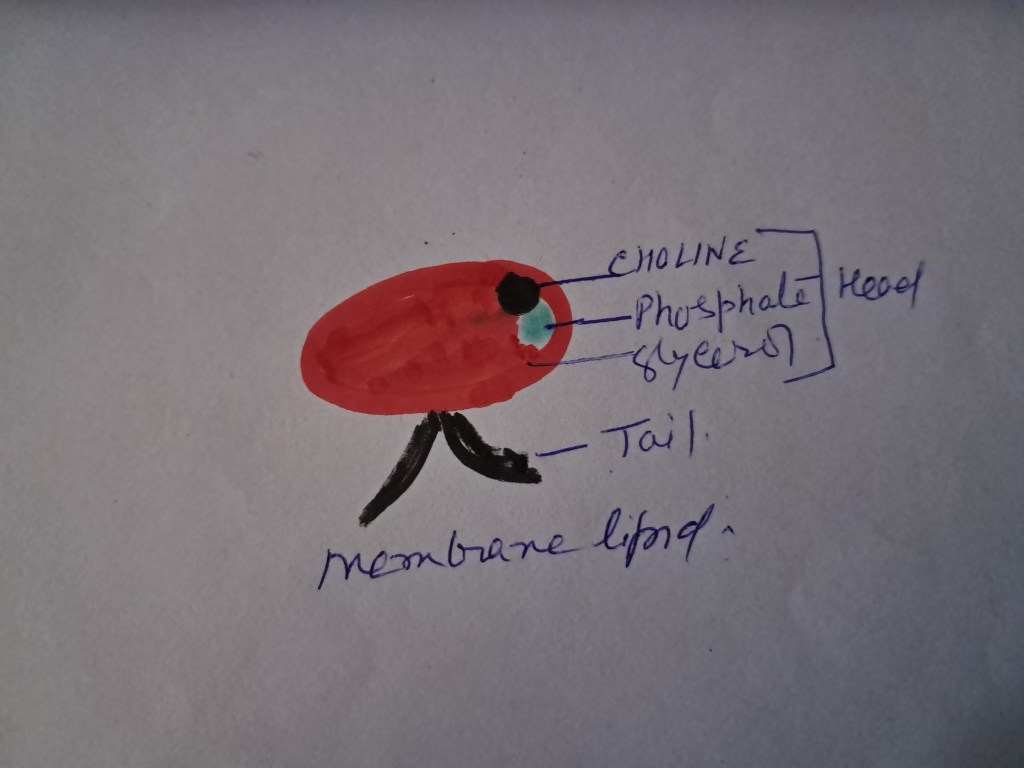
Chemically proteins are of two types :
1. Lipoproteins are lipid-plus proteins acting as enzymes and Ion channels.
2. Glycoproteins are carbohydrates + proteins that work as receptors for
neurotransmitters.
Types of proteins based on their presence on the cell membrane:
1. Intrinsic proteins present in the inner surface of the cell membrane
2. Extrinsic plasma proteins are on the outer surface of the plasma membrane and are also known as peripheral proteins. They provide strength to the cell cytoskeleton.
3. Transmembrane proteins extend throughout the cell membrane.
They function as:
- Channels: ions or small water-soluble molecules diffuse through these trans-membrane proteins. They are chemically glycoproteins.
2. Careers active or passive transport across the cell membrane Pumps
Receptors are glycoproteins that bind with hormones and initiate or trigger intracellular reactions.
There are numerous receptors on the cells. The number of receptors varies according to the need of the body.
Down-regulation occurs when the hormone or neurotransmitters are in excess. Their receptors decrease in number.
Up-regulation is when the hormones or neurotransmitters are in fewer amounts their receptors increase in number.
This up and down regulations of receptors are essential physiological phenomena. It explains denervation hypersensitivity and tolerance to some drugs.
Functions of cell membrane:
- Protection
2. Maintains ‘milieu interieur’- internal environment, i.e., the composition of intracellular and interstitial fluids.
In the 19th century, a French Physiologist ‘Claude Bernerd’, coined ‘milieu interieur’, a French word to describe the interstitial fluid and its capacity to maintain the internal environment within a normal range so that cells, tissues, and organs perform their functions smoothly.
Pinocytosis
Exocytosis
Provide framework-cytoskeleton
Link adjacent cells Work as enzymes, receptors, carriers, and channels.
Disclaimer:
Although every precaution has been taken to verify the accuracy of the information contained herein, the author assumes no responsibility for any errors or omissions. No liability is assumed for damage resulting from using the information contained within.

 learn-and-fly.co.in