Getting and maintaining idle body weight is a dream for everybody. So we struggle to lose weight.
Body weight maintenance is very tough. So many people try to lose weight with effort. We lose weight but fail to maintain that weight.
How to know whether you are obese or overweight?
BMI is body mass index: BMI of a person is the product of his weight in kg divided by his height in meter square. Body mass index is determined from a person’s weight in kg/meter squared height. It is expressed as kg per meter square.
How to calculate
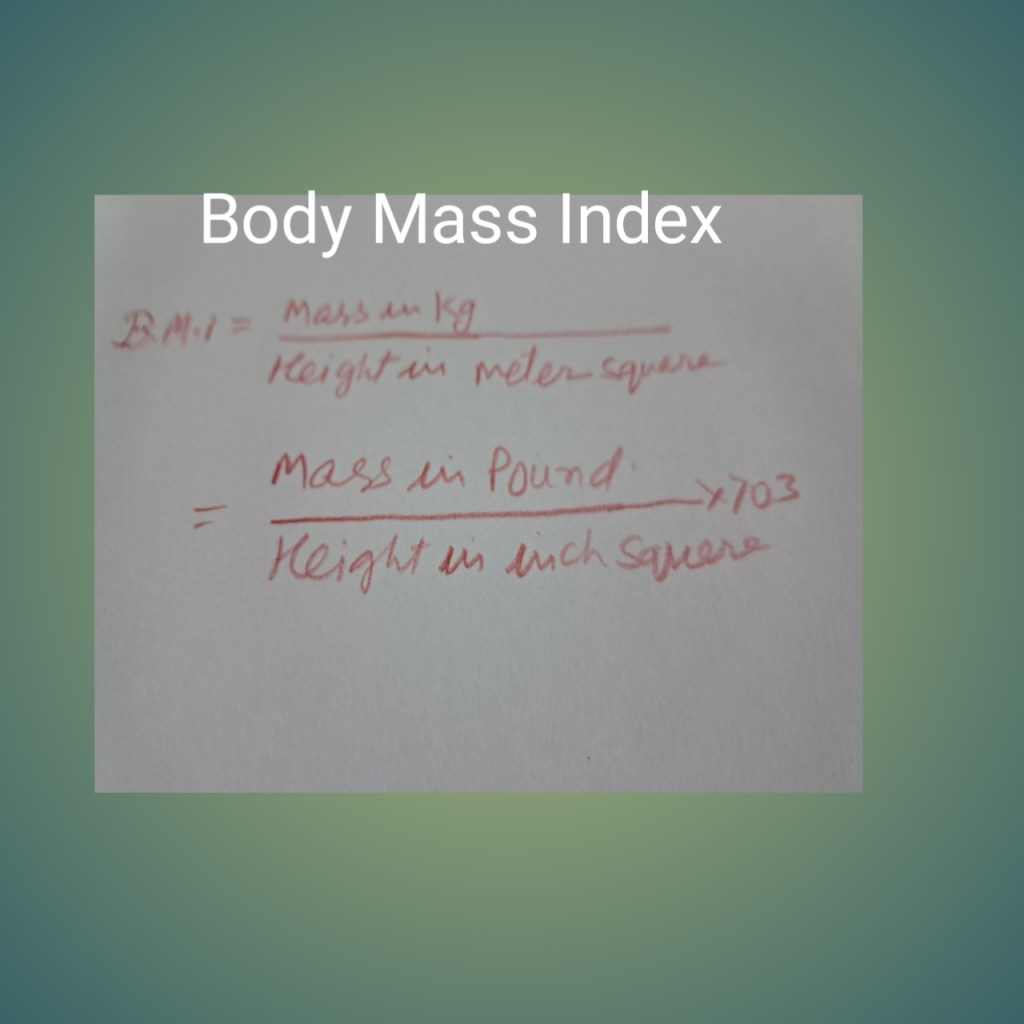
Weight is measured in kilograms by a measuring scale.
Now height in centimeters is taken by a stadiometer-a medical instrument to measure height. However, it can be measured with a measuring tape. First, marking is done on a plain wall using the measuring tape in centimeters. Then, the measured height is changed into meters by dividing the result by one hundred.
For example, the Weight of Sri Sam is 66kg.
Height is 166 cm. This is converted into a meter by dividing it by a hundred. That is 166÷100=1.66.
BMI= WEIGHT/ HEIGHT IN METER SQUARE
=66/1.66X1.66=23.95, Say 24 kg/sq meter square. =24.
So BMI of Sri Sam is 24.
A Stadiometer is used to measure your height.
Utility of BMI: It is a valuable method of measurement of the obesity of a person. It is the same for both sex and all ages in adults, but it needs to be modified in children. Based on BMI, adults are placed in the following category:
Category BMI Kg/meter square
1. Underweight 18.5
2. Normal weight 18.5-24.9
3. Overweight 25—29.9
4. Obese class type I 30-34.9
5. Obese class type II 35-39.9
6. Obese class type III >40
According to one international survey, in 2916,1.9 billion people were overweight, of which 60 million were obese, and the incidence of obesity is rising rapidly.
Some countries use lower values. For example, in Japan, BMI >25 is considered obese, while in China, it is >28.
Causes: Obesity is due to 1. Persistent positive energy balance, and
2. Body weight set point is raised.
Obesity is related to various conditions and syndromes, especially with Diabetic type -2, osteoarthritis, cardiovascular diseases, hypertension, obstructive sleep apnea, asthma, some cancers, etc.
It is associated with rare genetic syndromes like Prader-Willi, Bardet-Bedi, Crohn’s, and MOMO.
Individual causes are -diet habits, physical activity sedentary lifestyle.
Eating disorders like ‘binge eating syndrome ‘and night eating syndrome ‘are also responsible for obesity.
Socioeconomic factors,
Environmental factors
Endocrinal factors: Hypothyroidism, Cushing syndrome, Growth hormone deficiency, etc.
Genetic factors: Alteration is the various genes controlling appetite and metabolism predispose to obesity. Fat mass and obesity-associated genes (FTO gene ) are detected. There are many hypotheses, but none is widely accepted.
1. Thrifty gene hypothesis,
2. Drifty gene hypothesis
3. Thrifty phenotype hypothesis
Obesity shows inheritance. If both parents are obese, 80% of children will be obese. When both parents are normal, children are only 10% likely to be obese.
Carbohydrate insulin model –High glycemic load causes hormonal changes that promote caloric deposits in adipose tissue.
A calorie model-excess food intake and lack of physical activity.
Drugs; Insulin, sulfonylurea, steroids, phenytoin contraceptives, and many more.
Malnutrition in early life causes endocrinal changes, which may promote obesity later.
Obesity increases the risk of clinical depression, and depression increases the chance of developing obesity.
Gut flora also plays a vital role in the development of obesity.
The complication of obesity:
Directly-Increase in fat mass causes osteoarthritis, non-alcoholic fatty liver, and alters body response to Insulin. Cardiovascular disease, hypertension, lung diseases, mental disorders, gout, low back pain, multiple sclerosis, Carpel tunnel syndrome, etc.
Congenital disabilities, intrauterine fetal death, infertility, and pregnancy and delivery complications.
In certain conditions, obesity is helpful –positive effect, e.g., in heart failure or hemodialysis. This is the ‘Obesity survival paradox.’
Pathophysiology: Leptin, Ghrelin, and other appetite-related hormones act on the hypothalamus. Many pathways describe the development of obesity. However, the melanocortin pathway is widely accepted.
Arcuate nucleus influences 1. The lateral hypothalamus has the feeding center, and 2. The ventromedial nucleus has a satiety center.
One group of neurons in the arcuate nucleus secrete (a) Neuropeptide Y (NPY) and (b)Agouti-related peptide (AgRP). They stimulate the Lateral hypothalamus and inhibit the ventromedial nucleus.
The other group of neurons in the arcuate nucleus secrete (a) Preopiomelanocortin (PoMC) and (b) Cocaine and Amphetamine regulated transcript (CART). They inhibit the Lateral hypothalamus and
stimulate ventromedial nucleus.
Leptin stimulates the second group of the nucleus. Conversely, it inhibits the first group of the nucleus, so leptin deficiency will cause less inhibition to the ist group and less stimulation to another group of the nucleus, increasing overfeeding and obesity.
Prevention:-Change diet, reduce high fat and carbohydrate diet and increase dietary fiber.
Regular exercise.
BMI does not diagnose the health of an individual. This is just a screening test. Adolphe Quetelet, a Belgian astronomer, and statistician, developed the basis of BMI, what he called Social Physics. It was the basis of this BMI.
Ancel Keys coined the term BMI in 1972, although it is not as satisfactory as any other relative weight index indicator of relative obesity.
BMI does not differentiate the types of obesity. However, there are two major types of obesity.
1. Android or Central obesity: It is more common in males, and fat deposition is around the viscera of the abdomen. Due to this, the individual develops an apple-like body shape. This is closely related to cardiovascular disease, hypertension, and certain types of carcinoma.
2. Gynoid or peripheral obesity: It is more common in females. The fat deposition is around the buttock and upper part of the thigh. , the hips are rounded, and their buttocks appear large. Therefore these persons develop pear-like body shapes.
They are less susceptible to cardiovascular disease and hypertension. Now there are several ready reckoners. Just add the weight and height of a person, then from the ready, reckoner will say about the BMI.
BMI is straightforward to measure. Every person must know about this and used to check his BMI regularly and watch his fat content. In this way, a person can prevent the development of obesity.
Obesity and overweight are associated with multiple diseases like diabetes mellitus, hypertension, stroke, and cardiovascular diseases.
Some countries use lower values. For example, in Japan, BMI >25 is considered obese, while in China, it is >28.
Causes: Obesity is due to 1. Persistent positive energy balance, and
2. Body weight set point is raised.
Obesity is related to various conditions and syndromes, especially with Diabetic type -2, osteoarthritis, cardiovascular diseases, hypertension, obstructive sleep apnea, asthma, some cancers, etc.
It is associated with rare genetic syndromes like Prader-Willi, Bardet-Bedi, Crohn’s, and MOMO.
Individual causes are -diet habits, physical activity sedentary lifestyle.
Eating disorders like ‘binge eating syndrome ‘and night eating syndrome ‘are also responsible for obesity.
Socioeconomic factors,
Environmental factors
Endocrinal factors: Hypothyroidism, Cushing syndrome, Growth hormone deficiency, etc.
Genetic factors: Alteration is the various genes controlling appetite and metabolism predispose to obesity. Fat mass and obesity-associated genes (FTO gene ) are detected. There are many hypotheses, but none is widely accepted.
1. Thrifty gene hypothesis,
2. Drifty gene hypothesis
3. Thrifty phenotype hypothesis
Obesity shows inheritance. If both parents are obese, 80% of children will be obese. When both parents are normal, children are only 10% likely to be obese.
Carbohydrate insulin model –High glycemic load causes hormonal changes that promote caloric deposits in adipose tissue.
A calorie model-excess food intake and lack of physical activity.
Drugs; Insulin, sulfonylurea, steroids, phenytoin contraceptives, and many more.
Malnutrition in early life causes endocrinal changes, which may promote obesity in a later stage.
Obesity increases the risk of clinical depression, and depression increases the chance of developing obesity.
Gut flora also plays a vital role in the development of obesity.
The complication of obesity:
Directly-Increase in fat mass causes osteoarthritis, non-alcoholic fatty liver, and alters body response to Insulin. Cardiovascular disease, hypertension, lung diseases, mental disorders, gout, low back pain, multiple sclerosis, Carpel tunnel syndrome, etc.
Congenital disabilities, intrauterine fetal death, infertility, and pregnancy and delivery complications.
In certain conditions, obesity is helpful –positive effect, e.g., in heart failure or hemodialysis. This is the ‘Obesity survival paradox.’
Pathophysiology: Leptin, Ghrelin, and other appetite-related hormones act on the hypothalamus. Many pathways describe the development of obesity. However, the melanocortin pathway is widely accepted.
Arcuate nucleus influences 1. The lateral hypothalamus has the feeding center, and 2. The ventromedial nucleus has a satiety center.
One group of neurons in the arcuate nucleus secrete (a) Neuropeptide Y (NPY) and (b)Agouti-related peptide (AgRP). They stimulate the Lateral hypothalamus and inhibit the ventromedial nucleus.
The other group of neurons in the arcuate nucleus secrete (a) Preopiomelanocortin (PoMC) and (b) Cocaine and Amphetamine regulated transcript (CART). They inhibit the Lateral hypothalamus and
stimulate ventromedial nucleus.
Leptin stimulates the second group of the nucleus. Conversely, it inhibits the first group of the nucleus, so leptin deficiency will cause less inhibition to the ist group and less stimulation to another group of the nucleus, increasing overfeeding and obesity.
Prevention:-Change diet, reduce high fat and carbohydrate diet and increase dietary fiber.
Regular exercise.
Our genetic composition determines our body weight. Body weight is a hereditary trait.
Set point theory states that DNA determines a point weight point for every individual. So body weight fluctuates around this weight. Sometimes it may go up or down to some extent, but the body will try to gain that weight.
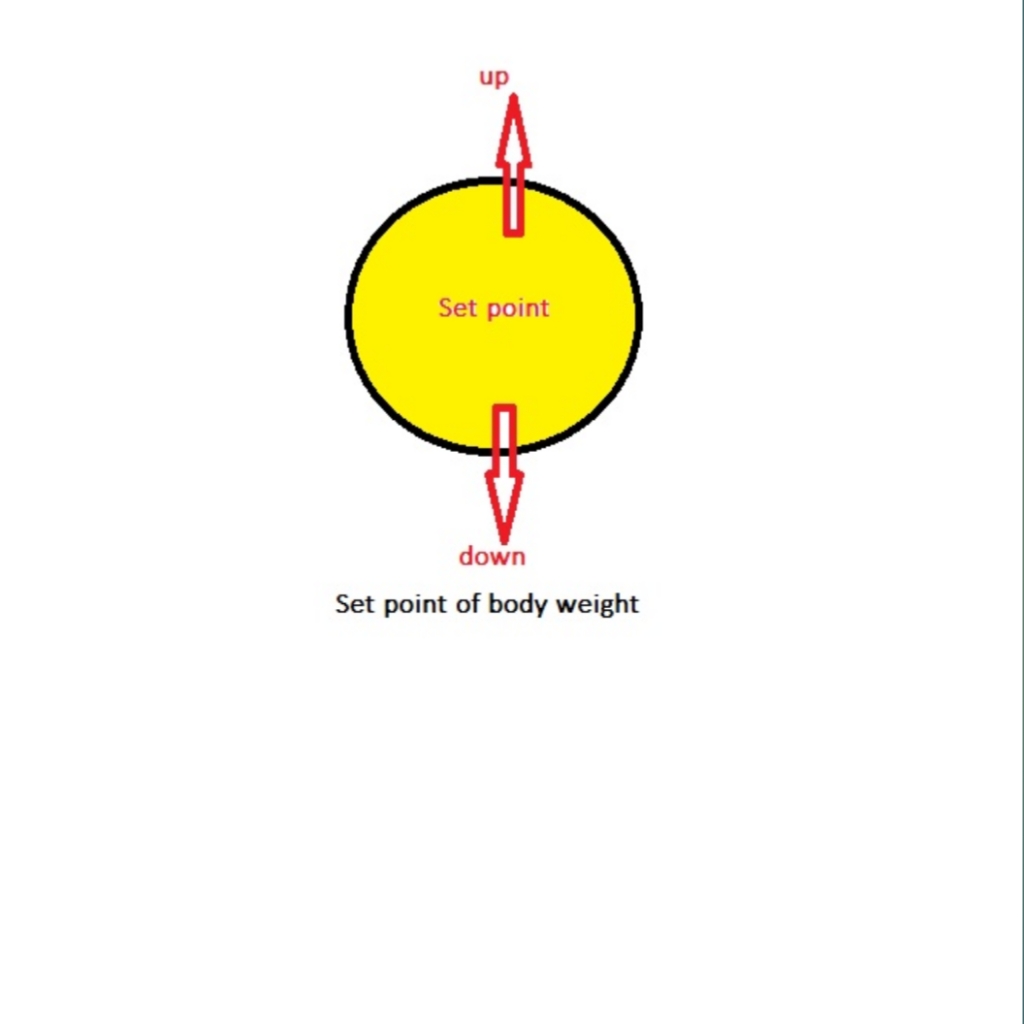
In other words, set point suggests that our body weight fluctuates up or down temporarily but will ultimately return to its genetically determined n set point.
Multiple signaling systems manage our body weight. The body regulatory system of the body keeps you at a steady state level or set point.
This theory states that some of us have higher weight set points than others.
This theory has yet to be widely accepted. Instead, the hypothalamus gets multiple signals from the body tissues and constantly adjusts metabolism.
The weight gain reactive signal system stops working correctly. After some time, leptin and insulin resistance develop, causing an increase in body weight.
Another theory regarding body weight is ‘the set point theory.’
Body weight is determined mainly by
Food intake – the energy used =Body weight
1. Inherited traits, genetic factors
2. Nonhereditary factors-hormonal.Psychological, diet habits, energy balance, etc.
If food intake, i.e., calories (Energy) taken, is more than the energy consumed, body weight will increase used and
If calories taken are less than the energy used, body weight will decrease.
Body weight increases if food intake is more than calories in physical exercise or catabolism is more (e.g., in thyrotoxicosis a D.M.).
If food intake is less (calorie intake is less) and more calories are used, then body weight decreases.
Can we change our set point weight?
The answer is yes. We can lower the set point of weight. But it needs slow and persistent efforts.
A gradual 10% step-down weight loss approach with constant maintenance will lower the Setpoint. Remember, slow and steady wins the race.
Minor adjustment is more beneficial than a strict calorie diet.
If you fail to lose weight and maintain your weight, healthcare providers can help you with a rapid weight-loss program is useless.
In this case, after some time, your body will oppose reduced calorie intake by sending a signal, e.g., Hunger pains and slowing down your metabolism and attempt to bring you back- to your standard set point.
How to calculate the calories in your diet?
1 gram of carbohydrate produces 4 calories. cereals-rice,wheat etc
one bread of 35 gm contains 10 gms water, so 25 gms carbohydrate -25×4=100 calories.
1 gram of protein yields 4 calories. pulses
1 gram of fat yields 9 calories.
water zero calories.
Vegetables 100 gms of tomato, cucumber, salad, etc. provide 20 calories.
100 gms mango, banana and potato yield =100 calories
100 gm, fruits give 50 calories.
1 teaspoonful 5gm sugar =5×4=20 calories.
Sweets 500 calories.
100 grams of fried foods, 1000 calories.
Calories demand of
Sedentary habit =1600 calories; 1/2 calorie in one minute in rest sleep.
1 calorie /minute in sitting,2 calories/ minute in standing, .walking 6 calories, running 10 calories /minute./day
Normal adult 2200 calories /day. Manual worker 3000 -3500 calories/day
To lose weight, reduce cereals, wheat, and pulses, and remove fat oils, etc., from your diet.
calculate your calories expense and calories intake. If intake is more than expense, you will gain weight; if expenses are more than income intake of calories, you will lose weight.
Body weight maintenance depends mainly [80%] on a diet and only 20% on physical work, exercise, etc. There is no need to follow any special diet plan, ketogenic diet, etc. Just take more vegetables, fruit, and juices, reduce cereals from your diet, and remove fat, alcohol, meat, fish, and poultry products from your diet.
As I have mentioned earlier, extra and heavy physical exercise is not very beneficial to lose weight.


 learn-and-fly.co.in