This article discusses progesterone functions. Here, learn about the site of average synthesis values and more.
Keywords: Pregnenolone | Progesterone| Basal body temperature (BBT) | corpus luteum | Syncytiotrophoblasts | proliferate | luteal -placental shift’| endogenous|
Table of contents
- Introduction
- Site of synthesis
- Steps of Synthesis
- Transport
- Functions of Progesterone
- Metabolism
- Mechanism of Action
- Regulation of Progesterone Secretion
Introduction
Progesterone is a steroid 21C, of course, endogenous in origin, and a progestogen sex hormone.
A progestogen is a group of steroid hormones. Progesterone is the main progestogen. The progestogen is an essential metabolic intermediate in synthesizing other endogenous steroids like sex hormones and corticosteroids.
Progestogen performs various functions as a neurosteroid essential for brain function.
Site of synthesis
Leading site
Progesterone is secreted mainly by “theca cells “of the corpus luteum and during pregnancy by the placenta in females. When ovulation fails, the corpus luteum is not formed. Therefore, progesterone synthesis will not take place. When pregnancy occurs up to six weeks, Progesterone is synthesized by the corpus luteum. The placenta synthesizes Progesterone and other hormones at six to eight weeks of pregnancy. This is known as the ‘luteal -placental shift.’ Syncytiotrophoblasts’ are the leading site of hormone secretion.
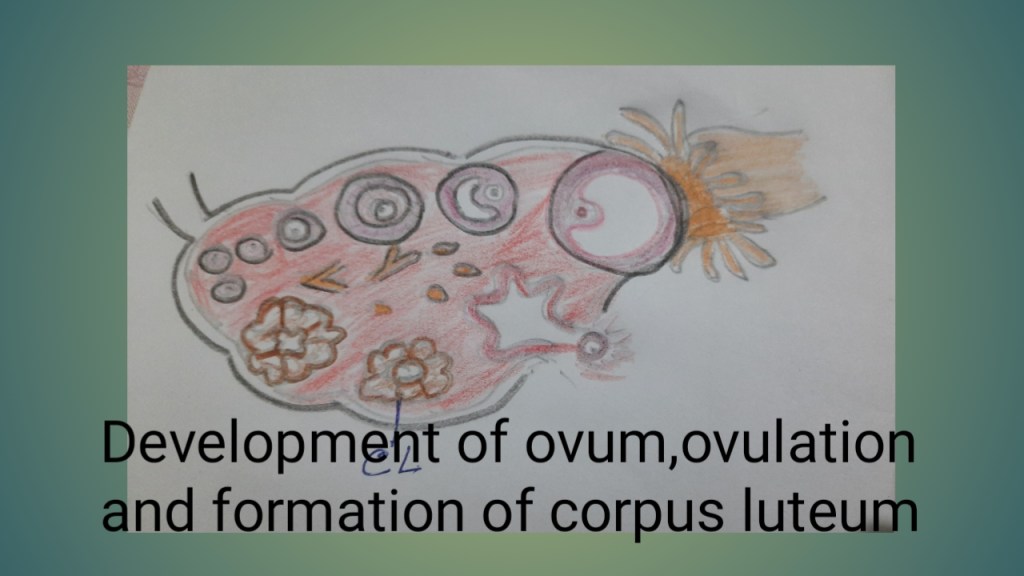
Photo by Sandhya Prasad
Minor sites
In small amounts, Progesterone is secreted from the adrenal gland in males and females.
Progesterone is also secreted to some amount in nervous tissues present in the brain and adipose tissues.
Animal source: Progesterone is present in milk products. Bioavailable progesterone level rises after the consumption of milk products.
Steps of Synthesis
The primary substrate is cholesterol. Cholesterol is oxidized to produce Pregnenolone.
Cholesterol –>Pregnolone –>Progesterone –> 17-hydroxyprogesterone.
17-hydroxyprogesterone –> androstenedione –> testosterone → estradiol→ estrone.
The average level of Progesterone: progesterone levels are low in female children and postmenopausal women.
In females, its level fluctuates during the menstrual cycle. During the follicular phase of the menstrual cycle, progesterone level is 0.9 nanograms per milliliter, and during the luteal phase, it rises by 20-fold.
In late pregnancy, the average synthesis of Progesterone is 250 mg/day.
After delivery, plasma progesterone level decreases rapidly and is not detectable after 24 hours.
In males, progesterone levels are only 0.3 nanograms per milliliter.
Transport
Progesterone circulates in the blood in the free and bound stages.
80% Progesterone is bound to albumin
18% Progesterone is bound to ‘gonadotropin binding glycoprotein’ (GBG).
02% Progesterone is in the free state.
Functions of Progesterone
In conjunction with estrogen, Progesterone stimulates the uterus’s growth and secretory changes in the endometrium. It has no action of its own. The stroma cells proliferate. The spiral arteries grow, become more coiled, and dilate. The length and diameter of the endometrial glands increase and become tortuous.
It inhibits the contraction of the myometrium.
Progesterone, along with estrogen, causes the development of the lobuloalveolar system of the breast during pregnancy.
Progesterone increases Basal body temperature (BBT) to some extent. At the time of ovulation, BBT increases by 0.50 °C (0.9 °F).
Under the influence of Progesterone, cervical secretion becomes thick and tenacious.
Progesterone has an Immunomodulatory role by inhibiting T-lymphocyte-mediated tissue rejection and protecting the conceptus.
Progesterone stimulates the rate of respiration.
Progesterone inhibits ovulation. Progesterone à(-) GnRH release from hypothalamus à (-) LH.
Progesterone decreases the effects of estrogen by
1. reducing the number of estrogen receptors, and
2. converting potent estrogen to a less potent derivative.
A large dose blocks the action of aldosterone on the kidneys, leading to increased loss of sodium-natriuresis.
Progesterone decreases myometrial excitability by stabilizing lysosomal membranes and inhibiting prostaglandin synthesis.
Progesterone antagonizes the action of estrogen | the female sex hormone, during labor.
Metabolism
Progesterone is rapidly metabolized by the liver to pregnanediol. Though extra hepatic tissues like the brain and skin also metabolize Progesterone.
So, sites of metabolism – mainly hepatic, and to some extent, Extrahepatic.
The main metabolic pathway is reduction. And then, conjugation occurs in the liver.
This pregnanediol conjugates to glucuronic acid, which is water-soluble and excreted in the urine.
When given orally, it is metabolized rapidly; therefore, it is used parenterally. But synthesized Progesterone can be given orally.
Mechanism of Action
Progesterone is secreted in increasing amounts from the trophoblast of the placenta. The precursor of pregnenolone is maternal cholesterol. In the endoplasmic reticulum, pregnenolone is converted into Progesterone by 3-beta-hydroxysteroid hormones, which readily diffuse passively across the cell membrane. Progesterone, being a steroid hormone, rapidly diffuses across the cell membrane. Progesterone enters all cells, but it has action only when progesterone receptors (PR) are present. It exerts effects mainly on the ovary, uterus, and breast. This is due to the presence of ‘progesterone receptors.
Progesterone receptors (PR) are of two types:
Nuclear progesterone receptors (NPR) and membrane progesterone receptors (PR)
Progesterone receptor is expressed in specific tissues, including the ovary, uterus, and breast.
Nuclear Progesterone receptors (NPR): Progesterone binds to and activates progesterone receptors in the cytoplasm. The progesterone receptor is a dimeric nuclear protein. Progesterone with a ‘nuclear progesterone receptor’ forms a complex that attaches to a specific DNA sequence, activates the transcription of target genes, and promotes cell replication and protein synthesis. The DNA sequence is known as the ‘hormone response element.’ This initiates new messenger RNA that causes cell replication and protein synthesis.
Progesterone with a ‘membrane progesterone receptor (PR)’ regulates oocyte maturation, sperm motility, labor, and cancer.
Progesterone acts as a ligand of the progesterone receptor membrane component 1(PGRMC1) and regulates metabolic functions and neuron viability.
Regulation of Progesterone Secretion
Under the higher centers, the Hypothalamus secretes releasing hormone, GnRH, which induces the release of luteinizing hormone (LH) from the anterior pituitary gland.
Luteinizing hormone (LH) activates ‘adenyl-cyclase’ in the corpus luteum.
Due to ‘adenyl-cyclase,’ more cyclic AMP is formed, which induces progesterone synthesis.
It has a negative feedback effect on the release of GnRH from the hypothalamus.
Cholesterol–>Pregnolone –>Progesterone –> 17-hydroxyprogesterone.
17-hydroxyprogesterone –> androstenedione –> testosterone → estradiol→ estrone.
Summary
Progesterone is essential for pregnancy.
Like to meet again? Sign up to get an email when I publish.
 learn-and-fly.co.in
Leave a comment