This article discusses estrogen – types,site of synthesis, and mechanism of action. Here, learn about the functions, metabolism, and more…
Keywords: Estrogen| testosterone||LH | FSH| Anterior pituitary | Hypothalamus |GnRH| secondary sexual characteristics|SHBG | gut brain axis
Table of content:
| 1. | Introduction and types |
| 2. | Site of estrogen synthesis |
| 3. | steps of synthesis |
| 4. | Regulation of secretion |
| 5. | Mechanism of action |
| 6. | Function |
| 7. | Transport |
| 8. | Metabolism |
Estrogen is the main female sex hormone that is secreted mainly from the ovaries. Chemically estrogens are steroids. Estrogens are secreted in all vertebrates and even in some arthropods.
Oestrogen -Estrone was isolated in 1929 for the first time.
Oestrogen originates from Ancient Greek ‘oestros’ ( a periodic state of sexual activity in female mammals) + ‘genos’ (generating). The term was used in 1920.
Site of estrogen synthesis:
- Ovaries –
Cells of theca interna of the Graafian follicles are the primary site of estrogen secretion.
Granulosa cells of the Graafian follicles—secrete estrogen, which remains in the Graafian follicles.
- Placenta during pregnancy
- Adrenal cortex -in small amounts
- Testis – in small quantities.
Synthesis of estrogen:
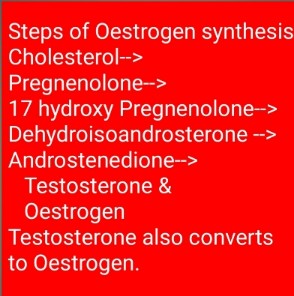
The primary substrate for steroid synthesis is cholesterol. Therefore, Oestrogen is also a steroid hormone synthesized from cholesterol.
Sources of cholesterol are
Acetate during the follicular phase, and
Low-density lipoprotein (LDL) during the luteal phase.
Also, uptake from the circulating blood.
Cholesterol is converted into Pregnenolone by the mitochondrial enzymes – cholesterol -desmolase in mitochondria of the theca interna cells. Cytochrome P450 family of enzymes in the mitochondria catalyze most steroidogenic cell reactions. Pregnenolone enters the endoplasmic reticulum (ER),
Where it is dehydrogenated by 3-beta hydroxysteroid dehydrogenase to form Progesterone
Progesterone is converted to 17-hydroxy Pregnenolone by 17-alpha hydroxylase.
17-alpha pregnenolone is converted into dehydroisoandrosterone (DHA).
Dehydroisoandrosterone (DHA) is converted in Androstenedione, which is converted mainly into Estrone, estradiol, and some testosterone. Testosterone and Androstenedione are aromatized under the influence of FSH to estrogens.
Control of secretion:
Two anterior pituitary gland hormones, FSH (Follicular stimulating hormone ) and LH( luteinizing hormone), contr̥ol estrogen secretion.
Effect on FSH:
Negative feedback: Oestrogen exerts negative feedback effects on FSH release by two direct methods: It reduces pituitary sensitivity to GnRH and decreases GnRH secretion, probably by decreasing dopaminergic activity.
Effect on LH:
In high concentrations, estrogen exerts a positive effect -increasing GnRH secretion from the hypothalamus and increasing sensitivity of the anterior pituitary to GnRH.
Daily secretion :
In females
1. During menstrual, daily secretion differs with two peaks phase.
One just before ovulation 200-500 microgram/day
The second peak occurs during the mid-luteal phase at 250 micrograms/day.
2. During pregnancy, daily secretion is only 15-45 mg.
3. After menopause, daily secretion is low.
4. Before puberty, it is low and shows a rising trend.
In males, estrogen secretion is low, about 50 micrograms/day.
Average estrogen level: Oestrogen level in blood is low. In males, estrogen levels are significantly down and have no essential physiological functions.
In females
In males
Types
There are four endogenous estrogens with estrogenic hormonal activity.
1. Estrone E1 is more in serum during menopause. Estrone was isolated and purified in 1929 for the first time.
2. Estradiol E2 is more potent and prevalent than other types of estrogens. From menarchy to menopause, Estradiol E2 is the most important estrogen in females in the non-pregnant state.
3. Estriol E3 is the predominant estrogen during pregnancy.
4. Esterol E4 is secreted only during pregnancy.
Estradiol is the most potent estrogen, which is ten times as powerful as Estrone which is ten times as potent as Estriol.
Estradiol potency=10 times of Estrone.
Estrone potency =0 times estriol.
Minor endogenous estrogens are also synthesized, with some activity, and their physiological importance is not evident. All estrogens are synthesized from androgens, mainly testosterone and Androstenedione.
Mechanism of action
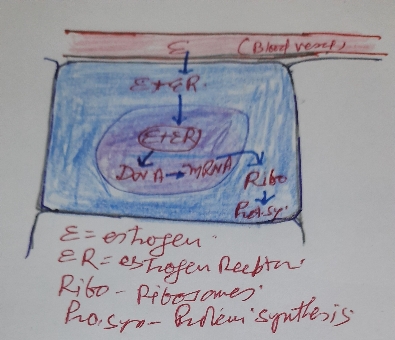
Steroid hormones readily diffuse passively across the cell membrane. Oestrogens being steroid hormones, rapidly diffuse across the cell membrane. Oestrogen enters all cells, but it has action only when estrogen receptors are present. It exerts effects mainly on the ovary, uterus, and breast. This is due to the presence of ‘estrogen receptors.
ER (estrogen receptor)is expressed in specific tissues, including the ovary, uterus, and breast.
In the cytoplasm, estrogens bind to and activate estrogen receptors. The Oestrogen receptor is a dimeric nuclear protein. Estrogen with estrogen receptors forms a complex that attaches to a specific DNA sequence to activate the transcription of target genes and promotes cell replication and protein synthesis. The DNA sequence is known as the ‘hormone response element.’
Estrogens are present at high levels in females of reproductive age and promote the development of ‘secondary sexual characteristics-for example, breast and endometrial thickening.
In males, estrogen is necessary for sperm maturation and essential for libido.
Before puberty, estrogen levels are deficient and exert little physiological effects.
At puberty, estrogen secretion increases and cause.
- Causes growth of internal genitalia -ovaries, uterus, and vagina. It is responsible for the maturation and maintenance of the vagina and uterus.
- It is responsible for ovarian cycle ovulation and corpus luteum formation.
- Stimulates myometrial thickening.
- Stimulates growth of the endometrium.
- It increases vaginal wall thickness and increases vaginal lubrication.
- Promotes external genitalia development-clitoris, labia majora, and labia minora.
- It increases osteoblastic activities -bone formation, and decreases osteoclastic activities -bone resorption.
- Increases binding protein synthesis by the liver.
- Increases synthesis of coagulation factors and decreases antithrombin III.
- Increases HDL and triglyceride and decreases LDL cholesterol. These effects prevent atherosclerosis and explain low Myocardial infarction in females.
- Increases cortisol secretion and sodium and water retention.
- Widening of hips.
- Female fat distribution.
- Essential for fertility.
- Estrogens are neuroprotective -DNA repair.
- Essential for mental health.
Transport
2-3% in free form in circulation is the active form of the hormone.
About 30% are bound to albumin and circulate.
About 68% are bound to ‘gonadal steroid binding globulin'( GBG) or ‘sex hormone binding globulin (SHBG).
Metabolism
Estrogens are metabolized mainly in the liver and, to some extent, In other tissues. Estrogens are conjugated in the liver with glucuronic acid to form water-soluble glucuronides and excreted in urine and bile.
Upon reaching the intestine, the bile portion is broken down by GUT flora and reabsorbed as active hormones. So in, liver diseases or disturbances in the gut flora alter this mechanism with disorders of menstrual cycles.
About’ learn-and fly.co.in’
These articles are part of my mission to provide trustworthy recent health information to support the general public, patients, and professionals worldwide.
Here you will find human physiology, anatomy, and health topics.
Summary
Estrogens are of four types – 1. Estrone 2. Estradiol 3. Estriol, and 4. Esterol
The primary female sex hormone is responsible for developing female genitalia and secondary sex characters.
Photo by – V.K.PRASAD
Hopefully, this article will be useful for you.
Follow me on Instagram.
And don’t forget to follow me on learn and fly .co.in.
I am more enthusiastic, and you can get new insights from my articles later.
Thank you.
FAQ :
Q. What does the estrogen hormone do?
A.Oestrogen acts on all parts of the body. In females, it is responsible for developing and maintaining reproductive organs and secondary sexual features. It is essential for mental health, the cardiovascular system, bones, and muscles.
In males, it is essential for libido and mental health.
Q. Types of estrogen?
A.
1. Estrone E1 is more in serum during menopause. Estrone was isolated and purified in 1929 for the first time.
2. Estradiol E2 is more potent and prevalent than other types of estrogens. From menarchy to menopause, Estradiol E2 is the most important estrogen in females in the non-pregnant state.
3. Estriol E3 is the predominant estrogen during pregnancy.
4. Esterol E4 is secreted only during pregnancy.
Estradiol is the most potent estrogen, which is ten times as powerful as Estrone which is ten times as potent as Estriol.
Estradiol potency=10 times of Estrone.
Estrone potency =0 times estriol.
Minor endogenous estrogens are also synthesized, with some activity, and their physiological importance is not evident. All estrogens are synthesized from androgens, mainly testosterone and Androstenedione.
Learn More :
1. About us
3. Disclaimer
4. Private policy
Please submit any comments about the article Pancreatic function test. The team will work hard to evaluate the statement and make appropriate corrections.
Help to improve the content.
Have a comment about the Pancreatic function test
Name:
Email:
Phone No.
Comment/question
Similar Articles
Internal link <strong>Testosterone|Male sex hormone</strong>https:// totalphysiology.com/gut brain axis
External link:
 learn-and-fly.co.in
One thought on “Estrogen |female sex hormone”